
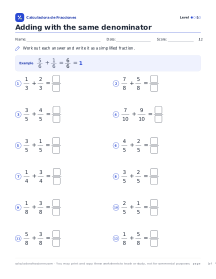
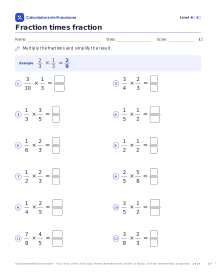
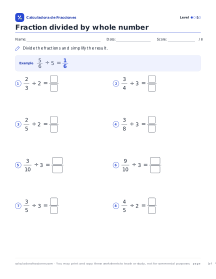
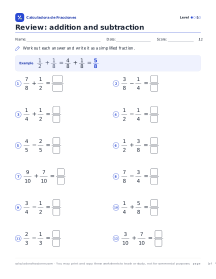
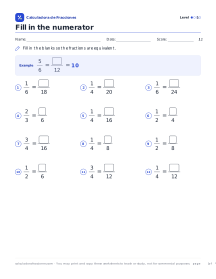
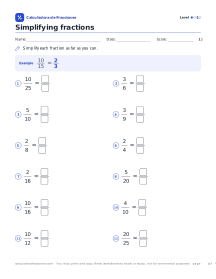
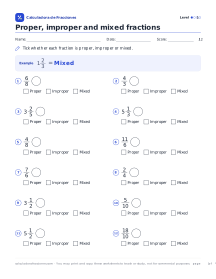
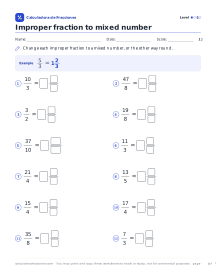
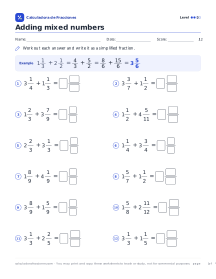
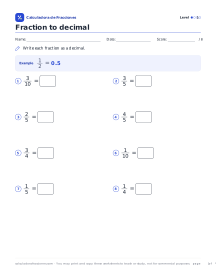
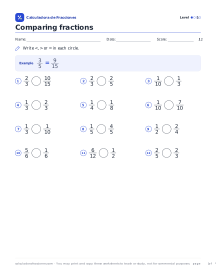
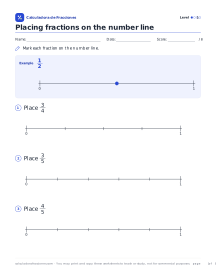
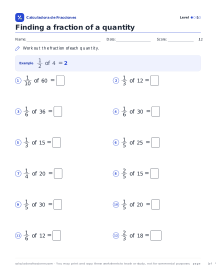
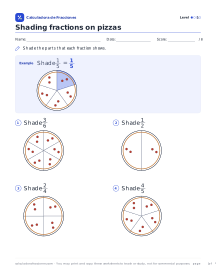
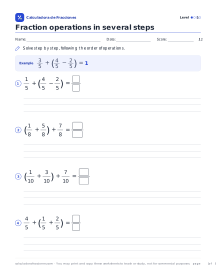
There are more than 350 PDF worksheets across 15 topics, almost all with an answer key. Choose the topic by what you want to practice; the table shows an example from five of them so you can tell them apart at a glance.
| I want to practice | Worksheet | Worked example |
|---|---|---|
| Reducing a fraction | Simplifying | 42/56 = 3/4, dividing by 14 |
| Adding or subtracting | Addition and subtraction | 1/6 + 1/4 = 5/12 |
| Multiplying | Multiplication | 2/3 × 9/10 = 3/5 |
| Dividing | Division | 2/3 ÷ 4/5 = 5/6 |
| Finding a part of a quantity | Fraction of a number | 3/5 of 40 = 24 |
The first column is the task and the second is the worksheet that trains it. The other topics, from equivalent fractions to combined operations, are in the topic map below. To see a whole sheet without downloading it, each topic shows its problems on the page itself, with the answers in an expandable section.
A sample worksheet problem, solved
Worked example: simplify 42/56
A simplifying worksheet asks you to reduce 42/56 to lowest terms.
- Find the greatest common factor (GCF, also called the GCD). The largest number that divides both 42 and 56 is 14, so GCF(42, 56) = 14.
- Divide both terms by 14. 42 ÷ 14 = 3 and 56 ÷ 14 = 4.
- Write the fraction. It becomes 3/4.
Result: 42/56 = 3/4.
Check: 3 × 14 = 42 and 4 × 14 = 56. Also, 3 and 4 have no common factors, so the fraction cannot be reduced further.
This is the kind of problem you will find on the simplifying fractions worksheet. To see the method with more cases, the simplify fractions calculator shows it in every result.
How the levels work
Levels run from 1 to 4 and set the size of the numbers, not the grade. In the topics with operations, denominators go up to 10 at level 1, up to 12 at level 2, up to 20 at level 3 and up to 30 at level 4. In topics without operations, such as equivalent fractions or the number line, the level raises the difficulty in a different way.
Level 1 uses only proper fractions, meaning the numerator is smaller than the denominator. Mixed numbers come later: in addition and subtraction, multiplication and division, from level 3. Worksheets have between 6 and 20 problems depending on the topic. The addition and subtraction, multiplication and division topics also include review sheets that mix cases.
If you are not sure where to start, try a level 1 sheet. If the student finishes it without mistakes, move to level 2 of the same topic. If they repeatedly miss one kind of problem, go back to the sheet for that case, not to an earlier level of the whole topic.
Topic map
Each link leads to a library of worksheets on that topic, with its level and length shown. On this page, “Featured worksheet” suggests a sheet for a specific topic and level, with its number of problems, and it changes every week.
- Addition and subtraction, from the same denominator to mixed numbers.
- Multiplication, with products that can be simplified before multiplying.
- Division, to practice the reciprocal of the divisor.
- All four operations, a sheet where you decide which operation is needed.
- Equivalent fractions, to fill in the missing term and decide whether two fractions are equal.
- Simplifying, to reduce down to lowest terms.
- Proper and improper fractions, to classify before calculating.
- Improper fractions and mixed numbers, converting in both directions.
- Mixed numbers, to add, subtract, multiply and divide with whole numbers and fractions.
- Decimals and percents, with the same amount written three ways.
- Comparing and ordering, which calls for a common denominator or a benchmark.
- Number line, to place and read fractions on a line.
- Fraction of a number, from the fraction to the number of objects.
- Shading and representing, to see the fraction before calculating it.
- Order of operations, with multi-step expressions.
Before practicing, review the idea in the guide what are fractions; it has no worksheet of its own. Once the student has the operations down, fraction word problems take them into real situations, and fraction worksheets by grade gathers the sheets by grade.
Downloads and formats
Each worksheet downloads as one PDF and its answer key as another, with the same name plus an answer-key ending, so you can hand out the sheet without the answers. The cut-out games have no answer key.
In the “Paper and printing” section of each worksheet you choose between Letter and A4, and between color and black and white. The problems are generated with exact arithmetic, the same kind the fraction calculator uses, and each sheet’s answers come from that calculation.
If you need other numbers, the fraction worksheet generator makes a sheet with your own settings. For students to check an answer with a hint, there is fraction practice. Cut-out games such as dominoes and memory cards are in the printable fractions section. The rest of the classroom materials are in teacher resources.
Sources
The printable worksheets build paper-and-pencil calculation, and interactive resources add the visual side. As a standards reference, the Common Core State Standards for Mathematics set out Grade 3 fractions, where the work is limited to denominators of 2, 3, 4, 6 and 8 (consulted October 17, 2026). Use it to match a worksheet to what a class is working on, or to review after correcting a sheet.