
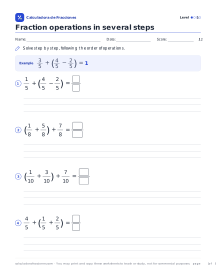
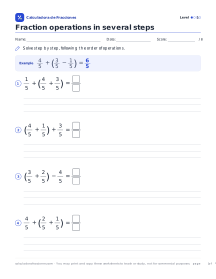
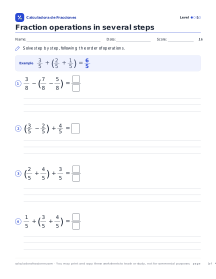
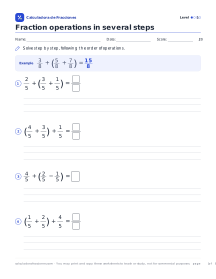
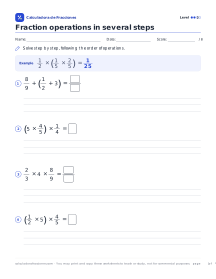
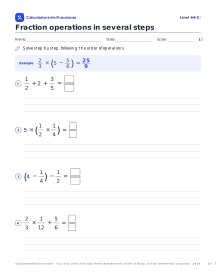
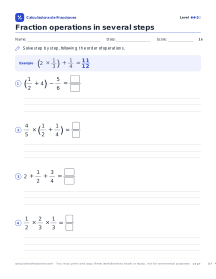
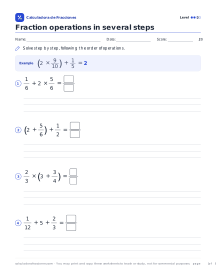
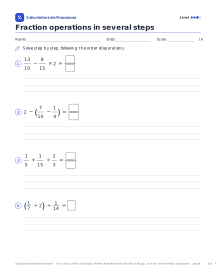
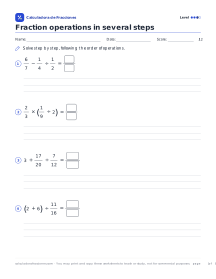
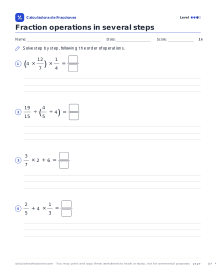
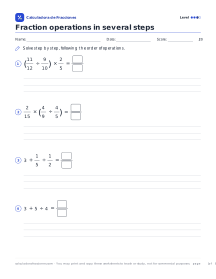
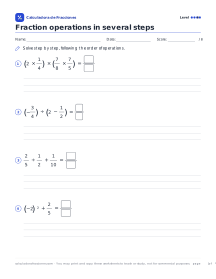
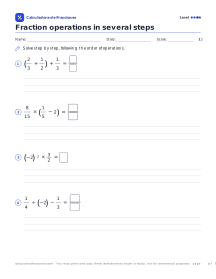
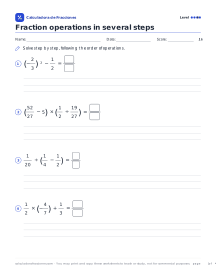
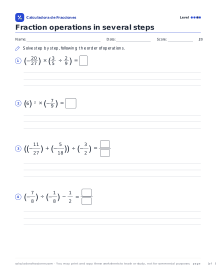
When a calculation mixes operations, the order decides the result: 1/2 + 3/4 × 2/3 equals 1, because you multiply first, while (1/2 + 3/4) × 2/3 equals 5/6. The worksheets make you decide that order in every problem. To check a whole expression, use the fraction expressions tool.
What worksheets there are
There are 16 worksheets: four levels, each with sizes of 8, 12, 16 and 20 problems. All come with a separate answer key. Between levels, the denominators, the operations and the shape of the calculation change:
| Level and skill | Denominators | Operations | Shape of the calculation |
|---|---|---|---|
| 1 · with parentheses | Up to 10 | Addition and subtraction | Three fractions with one set of parentheses |
| 2 · with and without parentheses | Up to 12 | Addition, subtraction and multiplication | With and without parentheses; whole numbers |
| 3 · with mixed numbers | Up to 20 | All four operations | Without parentheses there is always a priority operation; mixed-number results |
| 4 · with exponents | Up to 30 | All four operations | Two sets of parentheses, squares and negatives |
The biggest jump is between levels 2 and 3, where division appears and the results become mixed numbers. For other combinations, the fraction worksheet generator creates a new sheet, and fraction practice lets you review each operation on its own with automatic feedback.
The order, in four steps
- Parentheses: first what is inside, starting with the innermost.
- Exponents, before any product or sum.
- Multiplications and divisions, from left to right: 7/10 ÷ 7/15 × 2 = 3/2 × 2 = 3.
- Additions and subtractions, from left to right: 7/9 − 2/9 + 1/6 = 5/9 + 1/6 = 13/18.
To review each operation separately, the all four operations worksheets work well.
Worked problem: multiply before adding
Calculate the expression from the beginning and explain which operation goes first.
- Find the multiplication. There are no parentheses or exponents, so the product goes before the sum.
- Multiply. 3/4 × 2/3 = 6/12 = 1/2.
- Add. 1/2 + 1/2 = 1.
So the expression equals 1.
A level 3 problem
The level 3 worksheets include expressions where division goes before addition. If you add first, the result comes out different and larger.
Calculate 3/10 + 4/5 ÷ 8/15 and give the result as a fraction.
The division goes first: 4/5 ÷ 8/15 = 60/40 = 3/2. Then, 3/10 + 3/2 = 18/10 = 9/5.
A model answer would be “First I divide and get 3/2; then I add with common denominator 10 and get 9/5.” A student who adds first gets (3/10 + 4/5) ÷ 8/15 = 33/16, which is 2.0625, against 1.8 for the correct result.
What gets confused at each level
Each level tests a different confusion. In 1 the student forgets to work out the inside of the parentheses first, in 2 they add before multiplying, in 3 they add before dividing and in 4 they lose the sign of a square.
In level 4, with the sign inside the parentheses, (−1/3)² equals 1/9 and not −1/9; so (−1/3)² − 1/18 = 2/18 − 1/18 = 1/18.
Six problems of different kinds
Two are direct calculations, two are word problems (finding a part and finding the whole) and the last two ask you to compare two calculations and to calculate with a square.
Practice
- Calculate 7/9 − (1/9 + 2/9).
- Calculate 9/10 − 3/5 × 1/6.
- A trail is 420 yards long. Lia walks 2/7 of the trail in the morning and, of what is left, 3/5 in the afternoon. How many yards does she still have to go?
- A tank holds 3/5 of its capacity. 1/4 of what it holds is used and 18 gallons are left. What is its capacity?
- Which is worth more, 7/8 − 1/4 × 2/5 or (7/8 − 1/4) × 2/5? By how much do they differ?
- Calculate (1/3 − 3/8)² × 24.
Show the answers
- The parentheses equal 3/9 and 7/9 − 3/9 = 4/9.
- The product is 1/10, and 9/10 − 1/10 = 8/10, which simplified is 4/5.
- She has 120 yards left. After the morning 300 yards remain; in the afternoon she walks 3/5 of 300 yd = 180 yd, and 300 − 180 = 120.
- 40 gallons. 3/5 × 3/4 = 9/20 of the capacity is left; 18 gallons is 9 twentieths, each twentieth is 2 gallons and 20 × 2 = 40.
- The first is worth 31/40 and the second 1/4 = 10/40. The first is greater, and they differ by 21/40.
- The difference 1/3 − 3/8 is −1/24, its square is 1/576 and 1/576 × 24 = 1/24.
Notes for the teacher
- Ask for one line per operation and have students underline the one being solved at each step.
- The answer key can be used to grade in class or for each student to check their own worksheet when they finish, and it works best handed out after a first self-check.
- The guide to worked fraction exercises gathers more models for how to write up answers.
Sources
The Wikipedia article Order of operations gives the convention of evaluating parentheses first, then exponents, then multiplication and division, then addition and subtraction, with operations of the same precedence evaluated from left to right. It notes that this left-to-right rule is a convention that some calculators and programming languages treat differently, and that parentheses can be used to clarify an expression (consulted October 17, 2026).