
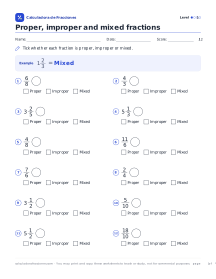
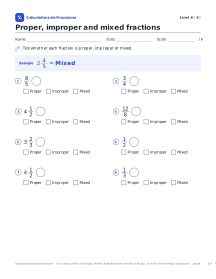
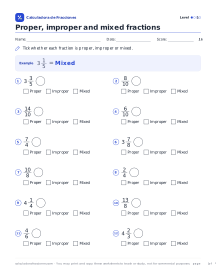
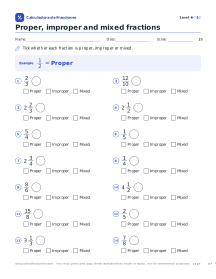
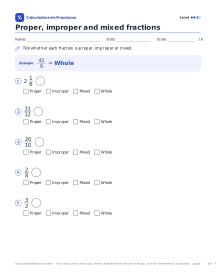
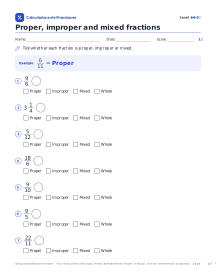
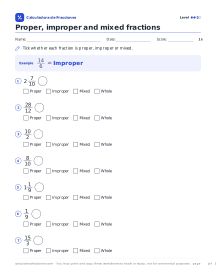
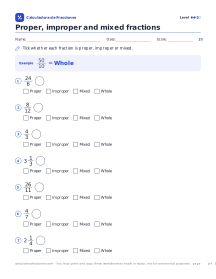
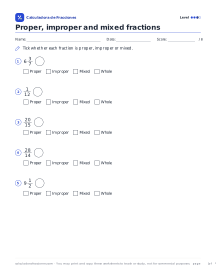
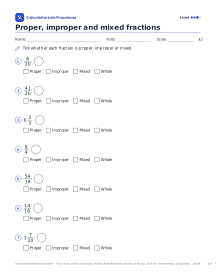
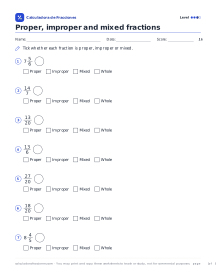
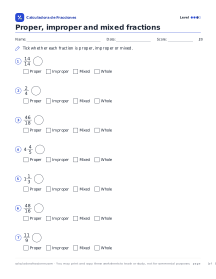
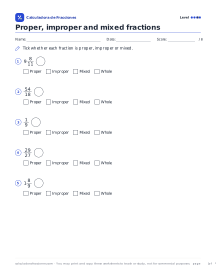
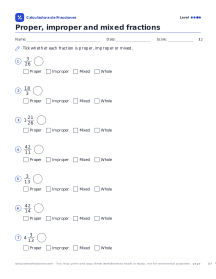
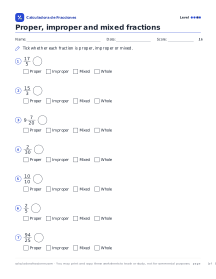
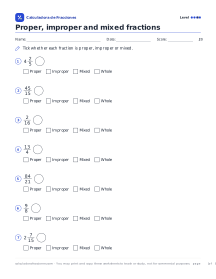
To classify a fraction, compare the numerator with the denominator. If it is smaller, the fraction is proper (3/5); if it is larger or equal, it is improper (7/4 or 4/4), although on these worksheets a fraction that equals a whole number, like 4/4, is marked as whole. The 16 PDF worksheets ask you to classify each number as proper, improper or mixed, and from level 2 also whole. Each worksheet comes with its own answer key as a separate file. To turn an improper fraction into a mixed number, the improper fraction to mixed number calculator shows the division.
Which worksheet to choose
The worksheets differ only by level and by number of problems, because they all work the same skill. The level sets the size of the denominators. Each problem shows a number and several boxes to mark: proper, improper and mixed, and from level 2 also whole.
| Level | Denominators up to | Boxes | Problems per worksheet |
|---|---|---|---|
| 1 | 10 | Proper, improper, mixed | 8, 12, 16 or 20 |
| 2 | 12 | Whole is added (8/4, 12/3) | 8, 12, 16 or 20 |
| 3 | 20 | Wholes with numerator equal to denominator (9/9) | 8, 12, 16 or 20 |
| 4 | 30 | The same four boxes | 8, 12, 16 or 20 |
The step up in level is one of size and not of idea: the larger the denominator, the less you can rely on the picture and the more you have to compare the two numbers. An 8-problem worksheet shows what the student recognizes and a 20-problem one helps lock it in.
What happens with 5/5 and 8/4
There are two conventions, and it helps to know which one each source uses. In the inclusive definition, the one followed by the guide to types of fractions, an improper fraction has a numerator greater than or equal to the denominator, so 5/5 and 8/4 are improper too, as well as whole. These worksheets separate the two ideas: a fraction that equals a whole number is marked as whole, and the improper fractions on the worksheet are always worth more than 1 and are not whole numbers, like 11/4 (2 3/4). The answer keys show it that way. If your textbook calls 5/5 improper, accept both answers.
On the first worksheet, a fraction that can be simplified is still proper, because the classification looks at the numerator and denominator as written.
Worked example, level 3
The problem chains three questions about the same number.
Worked example: a ribbon 23/6 of a foot long
A ribbon is 23/6 of a foot long. a) Is it a proper or an improper fraction? b) Write its length as a mixed number. c) Between which two whole numbers of feet does it fall?
- Compare the terms. The numerator 23 is greater than the denominator 6, so the fraction is improper.
- Divide. 23 ÷ 6 = 3 with 5 left over, because 3 × 6 = 18 and 23 − 18 = 5.
- Write the mixed number. The quotient is the whole part and the remainder goes over the same denominator: 3 5/6.
- Place it. With 3 whole feet and 5/6 more, the ribbon is between 3 and 4 feet.
Answer: a) improper. b) 3 5/6 feet. c) Between 3 and 4 feet.
Check: 3 × 6 + 5 = 23, and the starting numerator comes back.
Model answer for the notebook: “a) 23 > 6, so 23/6 is improper. b) 23 ÷ 6 = 3, remainder 5, so it measures 3 5/6 ft. c) Since 3 5/6 is between 3 and 4, the ribbon is longer than 3 ft and shorter than 4 ft.” A complete solution names the comparison, shows the division and gives the unit. A result without the division written out makes you guess whether the student calculated it or copied it.
The most repeated mistake with mixed numbers
Many students confuse a mixed number with a proper fraction because they see a fraction inside the number.
A second confusion comes up with wholes. 14/7 is nothing odd: 14 ÷ 7 = 2, so it equals the whole number 2.
Five problems to try before printing
- Mark each number as proper, improper, mixed or whole: 7/9, 11/5, 2 3/8, 14/7 and 15/15 (for the last one, also say how it is classified under the inclusive definition).
- A pitcher is filled with glasses of 1/4 quart, and 13 glasses have been poured in. Write 13/4 as a mixed number and say how many full quarts have been poured.
- Which is greater, 17/6 or 11/4? Rewrite both over a common denominator.
- A rope 4 2/5 feet long is cut into pieces of 1/5 foot. How many pieces do you get?
- A fraction with denominator 8 is improper, is worth less than 2 and has an odd numerator. Which numerators work?
Show the answers
- Proper, improper, mixed, whole (equals 2) and whole (equals 1; also improper under the inclusive definition)
- 3 1/4 quarts: 3 full quarts and a quarter more
- 17/6 = 34/12 and 11/4 = 33/12, so 17/6 is greater
- 22 pieces: 4 2/5 = 22/5 and each piece is 1/5
- 9, 11, 13 and 15, that is 9/8, 11/8, 13/8 and 15/8
For teachers
Before the worksheet, draw an improper fraction with two identical shapes: one complete and the other partly shaded. That shows that the numerator counts parts and that you may need more than fit in one whole. The coloring and drawing worksheets work for that visual step.
With a mixed group, a student who is slow to decide can write “greater” or “smaller” between the numerator and denominator before marking. A student who finishes early can add the mixed number form next to each improper fraction. The improper fractions to mixed numbers worksheets practice that conversion in depth. For automatic feedback, there is fraction practice with the level already chosen, and the fraction worksheet generator creates a sheet with other numbers.
Sources
The Wikipedia article Fraction defines an improper fraction as one whose absolute value is greater than or equal to 1, and says that any improper fraction can be converted to a mixed number and vice versa (consulted October 17, 2026).