
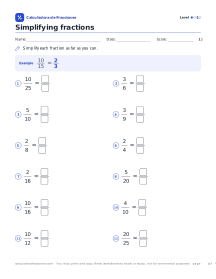
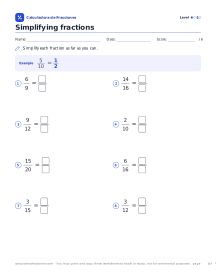
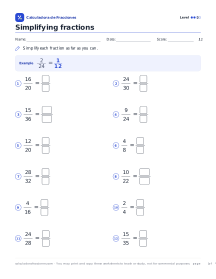
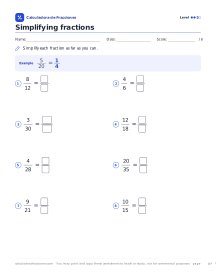
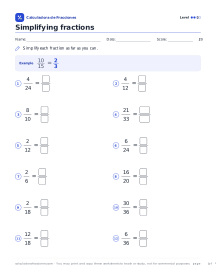
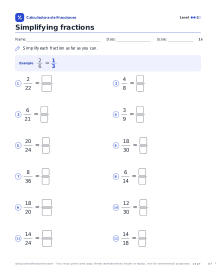
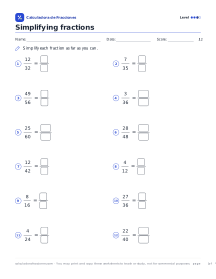
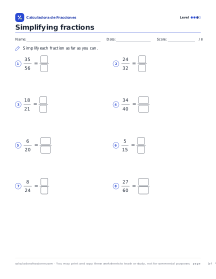
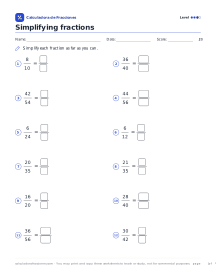
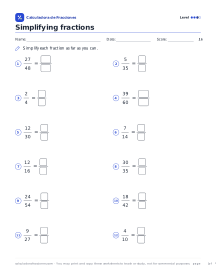
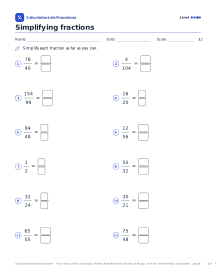
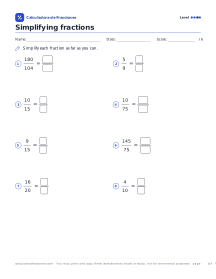
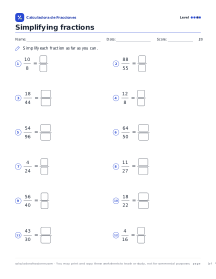
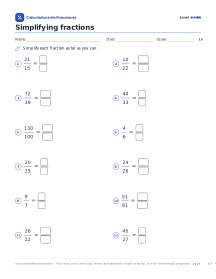
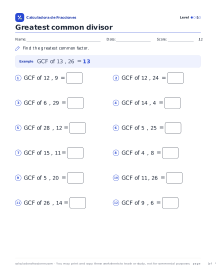
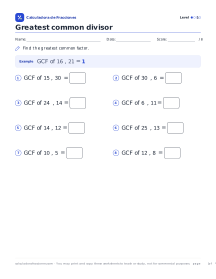
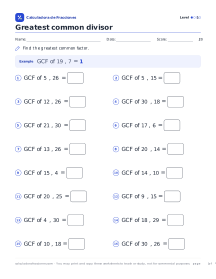
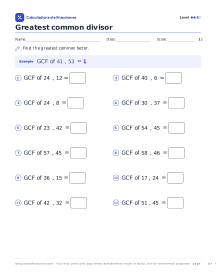
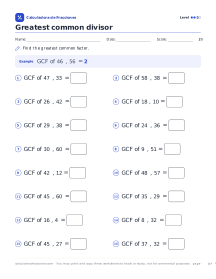
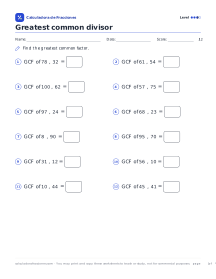
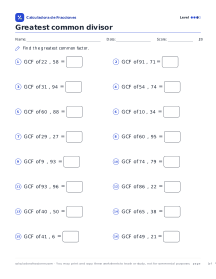
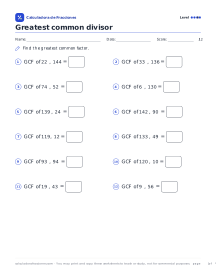
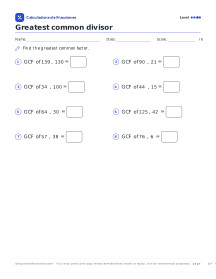
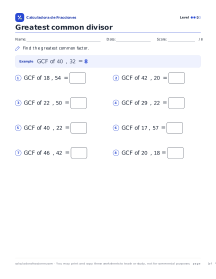
A fraction is simplified when the numerator and denominator share only the number 1. To get there, you divide top and bottom by their greatest common factor (GCF). Here you can download 24 PDF worksheets: 14 for simplifying and 10 for finding only the GCF, spread over four levels and each with an answer key. For example, 18/30 is divided by its GCF, 6, and becomes 3/5. To see the steps for a single fraction, there is the simplify fractions calculator.
Which worksheet to choose
The simplifying worksheets ask for the same thing in all four levels, which is to reduce each fraction to lowest terms. What changes is the size of the numbers and the common factor each fraction hides. The GCF worksheets work as a preliminary step, without fractions, for students who still hesitate when looking for factors.
| Level | Hidden common factor | Denominator of the given fraction | What else appears |
|---|---|---|---|
| 1 | 2, 3 or 5 | Up to 30 | Only fractions less than 1 |
| 2 | Up to 6 | Up to 36 | More variety of denominators |
| 3 | Up to 9 | Up to 60 | Denominators up to 60, almost always two digits |
| 4 | Up to 12 | Up to 120 | Fractions greater than 1 and some already in lowest terms |
The table suggests a path. With the small common factor of level 1, it is enough to try 2, 3 and 5, and from level 3 on it pays to find the GCF in one go. Each worksheet has 8, 12, 16 or 20 problems. The 8-problem ones work as a warm-up and the 20-problem ones as review. If you need other numbers, the fraction worksheet generator creates a new sheet.
A test problem, with its model answer
A level 3 problem usually hides the fraction in a situation and asks for the result in lowest terms.
Worked example: students who walk to school
In a class of 36 students, 24 walk to school. What fraction of the class walks? Give the answer as a fraction in lowest terms.
- Write the part over the total. 24 out of 36 is 24/36.
- Find the GCF. The factors of 24 are 1, 2, 3, 4, 6, 8, 12 and 24; those of 36 are 1, 2, 3, 4, 6, 9, 12, 18 and 36. The greatest one they share is 12.
- Divide both terms by 12. 24 ÷ 12 = 2 and 36 ÷ 12 = 3.
Answer: 2/3 of the class walks.
Check: the GCF of 2 and 3 is 1, so you cannot go further. Also, 2 × 12 = 24 and 3 × 12 = 36 give back the starting fraction.
Model answer for the notebook: a complete solution sets up the part over the total, names the GCF, shows the two divisions and ends with a sentence that answers the question. A student who prefers to divide a little at a time gets to the same place, 24/36 = 12/18 = 2/3, with one more step. What does not work is stopping at 12/18 without checking whether there is still a common factor.
Where students go wrong most at this level
In levels 3 and 4 the numbers usually have two digits, and there is a temptation to cross out digits that repeat. Sometimes it works out by chance, and that is why the mistake persists.
Another frequent mistake is stopping too soon. In 60/84, dividing by 2 gives 30/42 and dividing by 2 again gives 15/21, but both numbers are still divisible by 3. The GCF of 60 and 84 is 12 and leads straight to 5/7. To know whether you are done, check whether the two terms have a common factor greater than 1, and review the divisibility rules if they slip by you.
A third mistake confuses the GCF with the LCM. For 9 and 12, the GCF is 3 and the LCM is 36. Simplifying uses the GCF, and 9/12 becomes 3/4. The LCM is for adding with different denominators, and the guide on the difference between GCF and LCM compares them with more cases.
Six problems to try before printing
- Simplify 45/60.
- From a ribbon 48 inches long, 21 inches are cut. What fraction of the ribbon has been cut? Give the fraction in lowest terms.
- One of these fractions cannot be simplified. Which one? 15/24, 9/16, 14/35.
- A fraction has numerator 36 and simplifies to 3/4. What is its denominator?
- Calculate 7/30 + 11/30 and simplify the result.
- Simplify 12/30 and 14/35. Are they equal?
Show the answers
- 3/4, because the GCF of 45 and 60 is 15
- 7/16, because 21 and 48 both divide by 3
- 9/16. The number 9 divides only by 1, 3 and 9, and 16 is not a multiple of 3. The other two give 5/8 and 2/5
- 48, because 36 ÷ 3 = 12 and 4 × 12 = 48
- 18/30 = 3/5, dividing by 6
- Yes, both equal 2/5: 12/30 is divided by 6 and 14/35 by 7
For teachers
The sequence that works best goes from the GCF without fractions to the simplifying worksheet of the same level, and from there to the next level. A student who hesitates with divisions starts with the level 1 GCF. A student who finishes early can invent fractions with a given GCF, for example one that simplifies by 7, and pass it to a classmate. Always ask the student to explain how they simplified: the result is the same with several small divisors as with the GCF, and only the procedure shows whether they understand it.
The greatest common divisor calculator works with several numbers at once. When the numbers no longer allow a list of factors, the Euclidean algorithm finds the GCF with remainders. To practice with automatic feedback at the level you choose, use fraction practice.
Before this series, the equivalent fractions worksheets go well, since they run the opposite way, and after it come compare and order, where simplifying helps recognize equal fractions.
Sources
The Wikipedia article Fraction states that a fraction whose numerator and denominator share no factor greater than 1 is already in lowest terms, and that dividing both parts by their greatest common divisor gives the equivalent fraction with the lowest values (consulted October 17, 2026).