
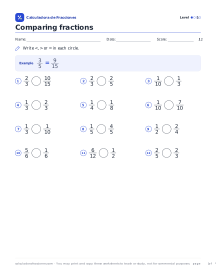
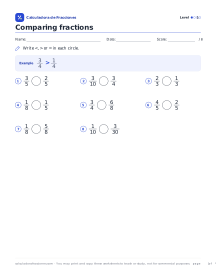
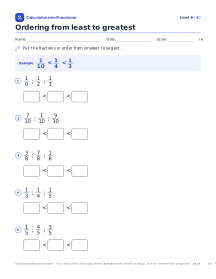
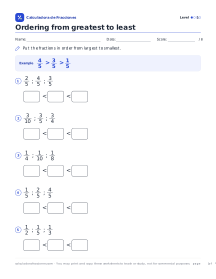
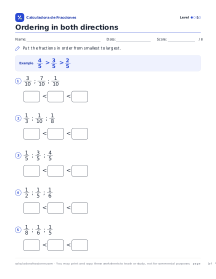
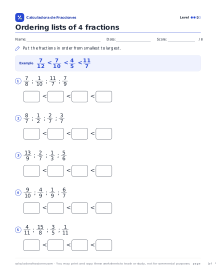
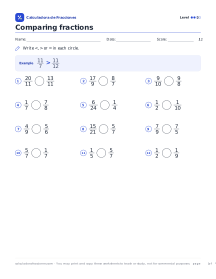
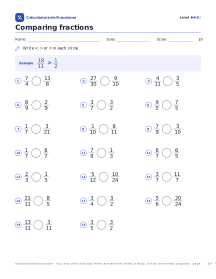
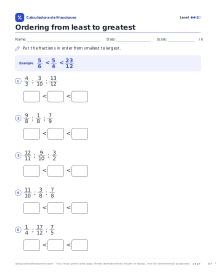
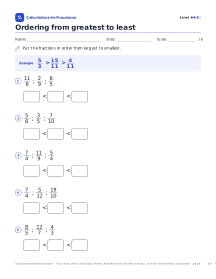
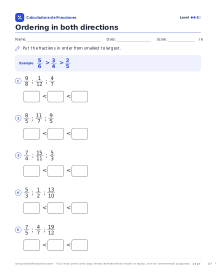
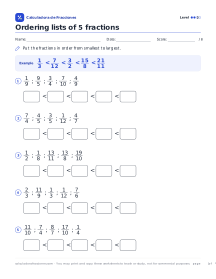
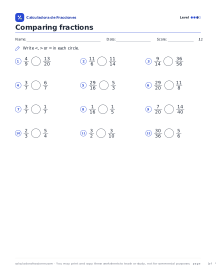
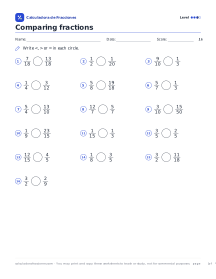
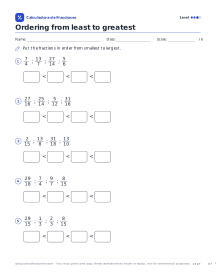
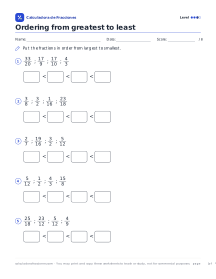
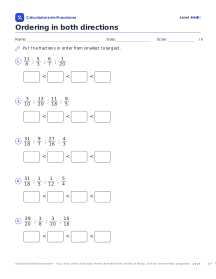
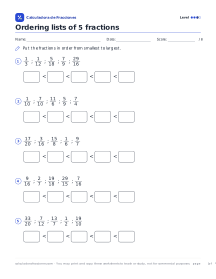
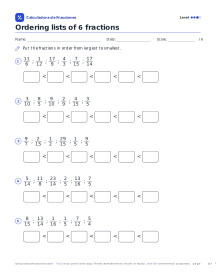
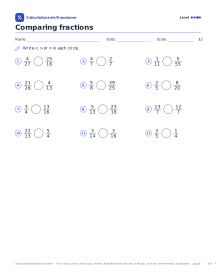
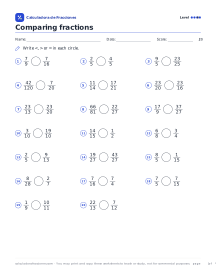
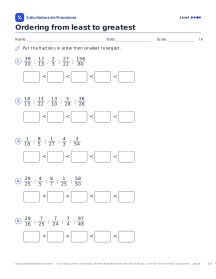
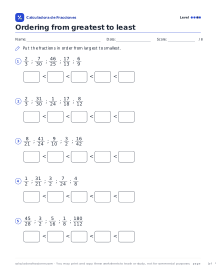
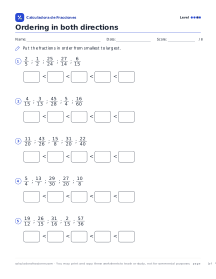
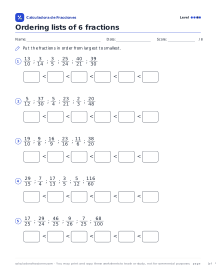
With the same denominator, the fraction with the greater numerator is the greater one: 7/8 > 5/8. With different denominators you have to rewrite both over a common denominator before comparing. This page collects 25 PDF worksheets for practicing with the signs <, > and = and for ordering lists of 3 to 6 fractions, each with its own answer key as a separate file.
What worksheets there are
The level sets the size of the denominators: up to 10 in level 1, up to 12 in level 2, up to 20 in level 3 and up to 30 in level 4. In level 1 all the fractions are proper; from level 2 they can be greater than 1. The table counts the worksheets at each level and says what strategy each type calls for:
| Level | Compare | Order | Strategy |
|---|---|---|---|
| 1 | 2 worksheets: 12 and 8 | 3 worksheets of 8, lists of 3 | Same denominator, same numerator and equivalent pairs (=) |
| 2 | 2 worksheets: 12 and 20 | 5 worksheets of 8: lists of 3, one of 4 and one of 5 | The above, plus one half as a benchmark and the common denominator |
| 3 | 2 worksheets: 12 and 16 | 5 worksheets of 8: lists of 4, one of 5 and one of 6 | Mainly one half as a benchmark and the common denominator |
| 4 | 2 worksheets: 12 and 20 | 4 worksheets of 8: lists of 5 and one of 6 | Common denominator; each list has two equivalent fractions |
At every level there are ordering worksheets from least to greatest, from greatest to least and mixed, so check the direction before starting. For other numbers, the fraction worksheet generator creates a new sheet, and fraction practice gives instant feedback with the level already chosen.
Worked problem: 3/4 and 5/6 of a yard
One rope is 3/4 of a yard long and another is 5/6 of a yard. Which is longer?
- Find the common denominator. The LCM of 4 and 6 is 12.
- Convert. 3/4 = 9/12 and 5/6 = 10/12.
- Compare the numerators. Since 9 < 10, 9/12 < 10/12.
Result: 3/4 < 5/6, so the second rope is longer.
Check: in decimals, 0.75 < 0.83.
Cross-multiplication, or the butterfly method, gets to the same place without calculating the LCM: 3 × 6 = 18 and 5 × 4 = 20, and 18 < 20. It is the same comparison with a common denominator of 24 instead of 12. The compare fractions calculator does it with any pair.
A level 3 test problem
A test at this level usually asks you to order a short list and explain how you did it. The denominators are different and the fractions are close to each other, so guessing is not enough:
Order 2/3, 5/8 and 7/12 from least to greatest and write the method.
The LCM of 3, 8 and 12 is 24. The three fractions become 16/24, 15/24 and 14/24. The numerators, from least to greatest, are 14, 15 and 16.
Model answer: “The common denominator is 24 and the three fractions become 16/24, 15/24 and 14/24. So 7/12 < 5/8 < 2/3.” The answer ends with the original fractions and not with the numerators, because the list asked for is the list of fractions. To check it, look at how much each exceeds one half: 14/24 exceeds 12/24 by 2/24, 15/24 by 3/24 and 16/24 by 4/24.
What gets confused at each level
In level 1 students look at the denominator and not at the size of the parts. In level 2 the second mistake appears, which is looking only at the numerator. In levels 3 and 4, close cases and lists with an equivalent pair weigh more.
The level 2 mistake is comparing only the numerators. In 3/8 and 2/5, the 3 is greater than the 2, but 3/8 = 15/40 and 2/5 = 16/40, so 2/5 is greater. In level 4, the equivalent pair is written with the = sign and no order is forced between the two equal ones, as in problem 5.
Six problems of different kinds
Some ask you to compare, others to find a part, a total or to chain two steps.
Practice
- Write <, > or = between 5/9 and 4/7.
- Order from greatest to least 3/10, 1/3 and 2/7.
- Two hikers move along: Ana covers 3/5 of the trail and Ben 7/12. Who is farther ahead, and what fraction of the trail is the lead?
- A tank is filled to 3/7 and holds 12 gallons. What is its capacity, and is it fuller than another that is at 2/5?
- Order from least to greatest, with the = sign where needed: 1/5, 2/9, 4/18 and 1/4.
- Without calculating a common denominator, use one half as a benchmark to decide whether 4/9 is greater than 5/8.
Show the answers
- 5/9 < 4/7, because 35/63 < 36/63.
- 1/3 > 3/10 > 2/7. With denominator 210 they are 70/210, 63/210 and 60/210.
- Ana is farther ahead: 3/5 = 36/60 and 7/12 = 35/60. Her lead is 1/60 of the trail.
- Capacity 28 gallons: 12 ÷ 3 = 4 gallons per seventh, and 4 × 7 = 28. Since 3/7 = 15/35 and 2/5 = 14/35, it is fuller.
- 1/5 < 2/9 = 4/18 < 1/4. With denominator 180 they are 36/180, 40/180, 40/180 and 45/180.
- No: 4/9 is below one half and 5/8 is above it, so 4/9 < 5/8.
Notes for the teacher
- Always ask for a sentence of method next to the sign: “I rewrote them over 24” or “one is below one half and the other above.”
- A student who is unsure can place the fractions on a number line; a student who moves fast can order without calculating and justify each step. The guide to benchmark fractions develops that tool.
- The comparisons assume the two fractions are parts of the same whole, something the guide on fractions of the same whole develops.
- It helps to master equivalent fractions first. To order long lists and check the result, use the order fractions calculator.
Sources
The Wikipedia article Fraction explains comparing fractions: with the same denominator you compare the numerators, with different denominators you find a common denominator, and you can compare ad and bc without evaluating bd (consulted October 17, 2026).