
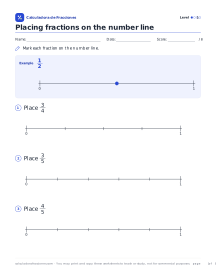
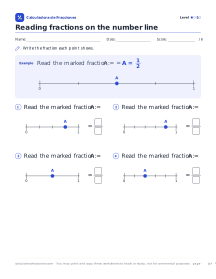
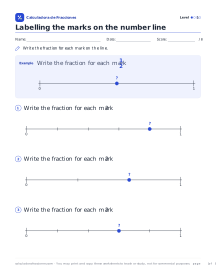
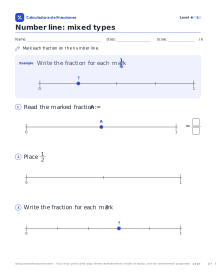
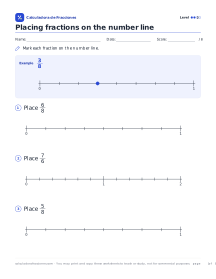
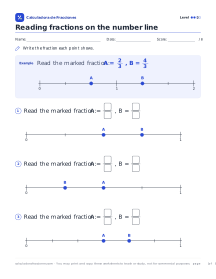
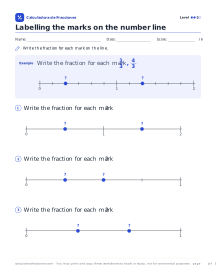
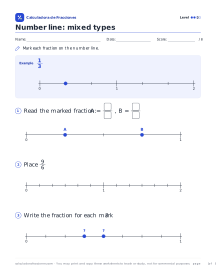
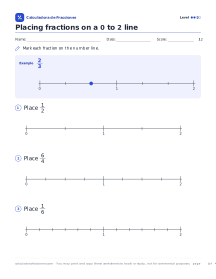
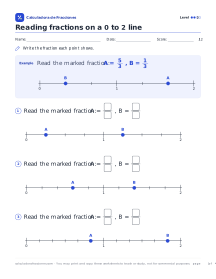
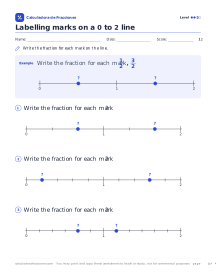
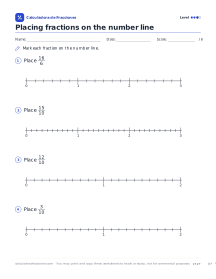
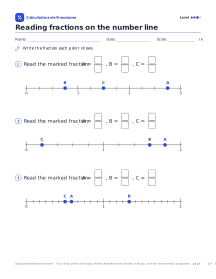
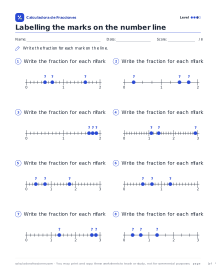
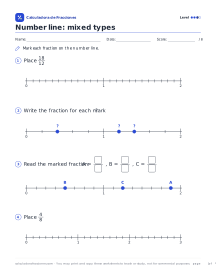
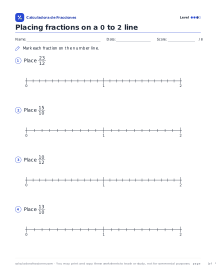
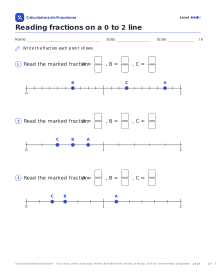
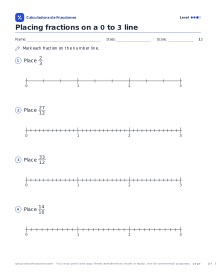
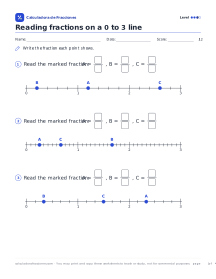
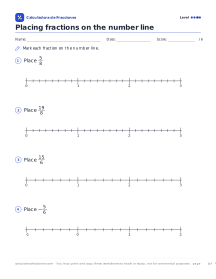
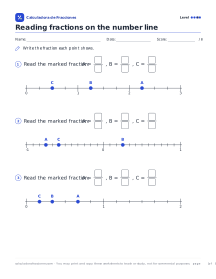
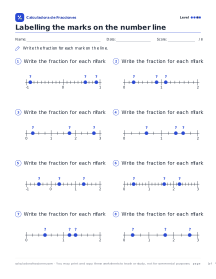
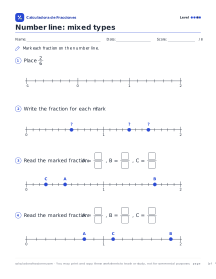
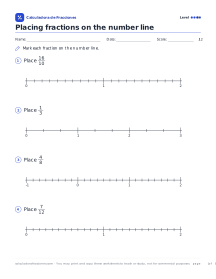
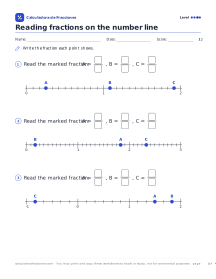
These worksheets teach how to place a fraction on a number line, how to read the fraction a point marks and how to fill in the missing marks. There are four levels: as you go up, the line gets longer and each unit is split into more spaces. The rule that holds all the work together fits on one line: the denominator counts the spaces in one unit, not the marks.
Worked example: reading point A on a line from 0 to 2
The line goes from 0 to 2 and is divided into 8 equal spaces. Point A is at the seventh mark counting from 0. What fraction does it mark?
- Count the spaces in one unit. From 0 to 1 there are 4 spaces, so each one measures 1/4.
- Count the spaces up to the point. From 0 to A there are 7 spaces.
- Write the fraction. That is 7 spaces of one fourth: 7/4.
- Turn it into a mixed number if you like. With 4 fourths you reach 1 and 3 are left over, so 7/4 = 1 3/4.
Result: A = 7/4 = 1 3/4, between 1 and 2.
Check: 1 3/4 = 1.75, a little less than 2, and A is just before 2.
The mistake of reading 7/8 appears when the whole line is taken as a single unit, because there are 8 spaces in all. If the line goes up to 2, the denominator comes from the spaces in one unit.
What changes at each level
Each worksheet works on one of three skills or a mix: placing a given fraction, reading the fraction of one or several points labeled with letters, or completing the marks flagged with “?”. All come with an answer key.
| Level | Line | Spaces per unit | Points per problem |
|---|---|---|---|
| 1 | From 0 to 1 | 2, 3, 4 or 5 | 1 |
| 2 | From 0 to 1 or from 0 to 2 | From 2 to 8 | 2 |
| 3 | From 0 to 2 or from 0 to 3 | From 2 to 12 | 3 |
| 4 | Long lines and lines that start at −1 | From 3 to 12 | 3 |
In level 4 a fraction can be negative: on a line from −1 to 1 with 5 spaces per unit, the point at the third mark to the left of 0 is −3/5. On the placing worksheets, only one point is asked for, whatever the level.
A level 3 problem, with a model answer
In level 3 the lines reach 3 and the points go past 2. This is a three-part problem like those on the worksheets, with the answer a student should write.
A line goes from 0 to 3 and each unit has 5 equal spaces. Point B is at mark 11 and point C at mark 7, counting from 0. a) Write the fraction for B. b) Which point is farther to the left? c) What is the distance between C and B?
Model answer. a) Each space measures 1/5 and B is 11 spaces from 0, so B = 11/5 = 2 1/5. b) C is 7 spaces away and B 11, so C is farther to the left; C = 7/5 = 1 2/5. c) The distance is 11/5 − 7/5 = 4/5, which is 4 spaces on the line.
A complete answer names the spaces that were counted and not just the result. If the student writes 11/15 in part a, they divided by the 15 spaces of the whole line, and it helps to go back to the step of counting the spaces in a single unit.
Another mistake is thinking that a larger denominator lands farther to the right. Between 0 and 1, 1/3 is to the left of 1/2, because when the unit is split into more parts, each part is smaller.
Practice before printing
- A line from 0 to 1 has 8 equal spaces. What fraction does the point at the fifth mark show?
- On a line from 0 to 2 there are 6 spaces per unit. At which mark, counting from 0, is 3/2 located?
- On a line from 0 to 1, point P is at 5/6 and point Q at 7/8. Which one is farther to the right?
- A 3-mile stretch is drawn on a line from 0 to 3, with 1 mile per unit. A person has walked 9/4 miles. What fraction of a mile is left to reach 3?
- The point 3/10 is at the third mark of a line from 0 to 1, and each space measures 1/2 inch on the paper. How long is the whole unit on paper?
Show the answers
- 5/8
- At mark 9, because 3/2 = 9/6 and each space measures 1/6.
- Q. P is 1/6 short of 1 and Q is 1/8 short, which is less; so Q is closer to 1.
- 3/4. The 3 equals 12/4 and 12/4 − 9/4 = 3/4.
- 5 inches, because the unit has 10 spaces of 1/2 inch.
How to use the worksheets
One possible sequence is to start with level 1 on the worksheets that complete marks, which make you count spaces before marking anything. Then move on to placing and reading, and go up a level when the answers come out without counting on a finger. If the student hesitates, repeat a worksheet of the same type before going up. With a strip of paper folded into equal parts, the student can check each answer, and if you prefer to draw the line yourself, the guide on dividing a segment into equal parts shows how.
To see a specific position before printing, use the fractions on a number line tool. To estimate whether a point falls before or after 1/2 without counting, see benchmark fractions.
What to do before and after
The coloring and drawing fractions worksheets prepare the idea of equal parts, and the proper and improper ones practice the fractions greater than 1 that appear from level 2. After that, comparing and ordering fractions uses the line to decide which is greater. With fraction practice you can work with automatic feedback, and the fraction worksheet generator lets you pick another combination of levels.
In the US, the Common Core standard 3.NF.A.2 asks students to understand a fraction as a number on the number line and to represent fractions on a number line diagram: to place a/b, mark off a lengths of 1/b starting from 0 (Grade 3, Number and Operations in Fractions, consulted October 17, 2026). Check your state standards, because the sequence by grade can differ.