
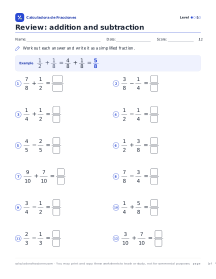
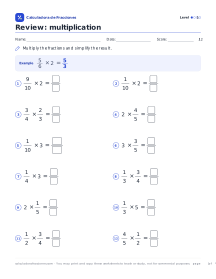
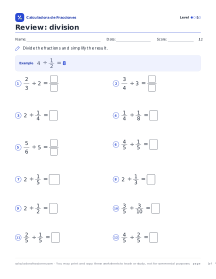
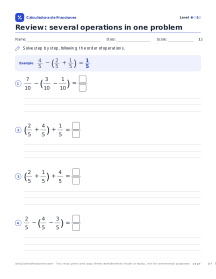
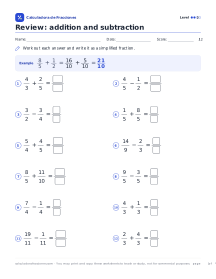
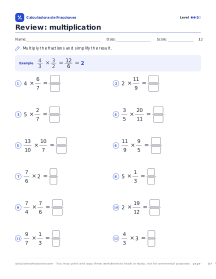
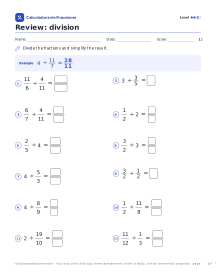
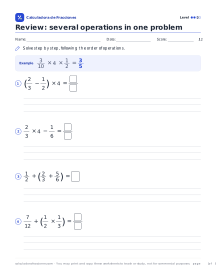
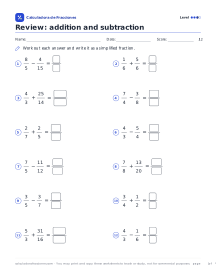
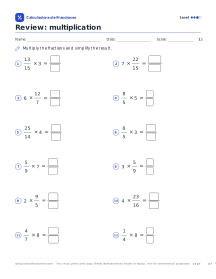
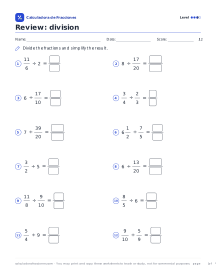
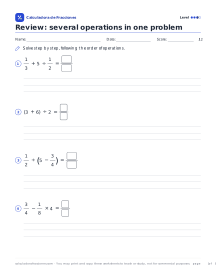
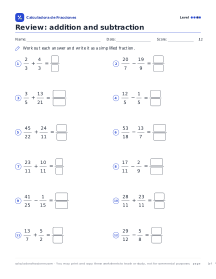
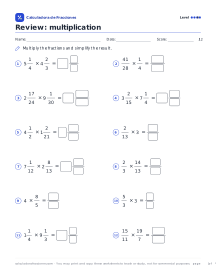
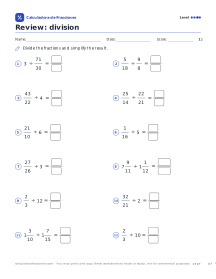
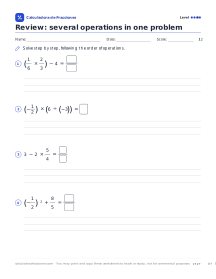
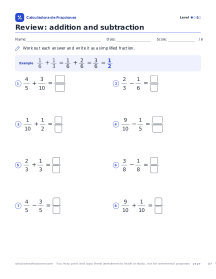
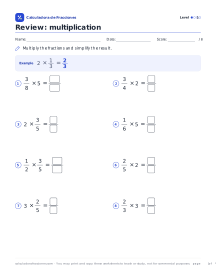
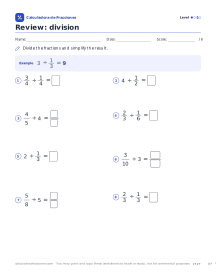
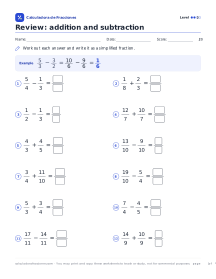
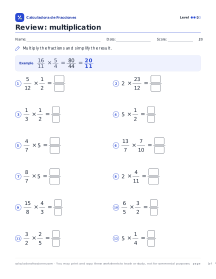
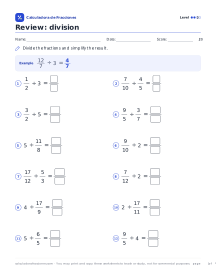
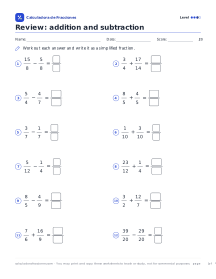
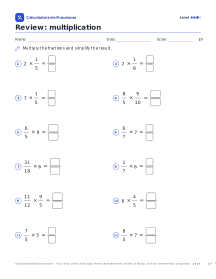
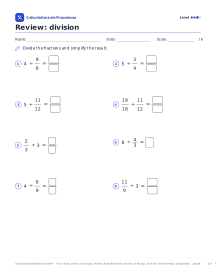
An all-four-operations worksheet looks like a test: the sign changes from one problem to the next and the student decides which procedure to apply. This page collects 25 PDF worksheets, each with its own answer key as a separate file, and starts with a short quiz of four calculations that shows where things go wrong. To review the method for each operation there are the fraction operations, and here you only practice.
Which worksheet to choose, by the sign that fails
Solve these four calculations without help. The one you miss points to the worksheet to start with.
| Calculation | Procedure | Check | If it fails, worksheet |
|---|---|---|---|
| 1/2 + 1/3 = 5/6 | Convert to sixths: 3/6 + 2/6 | 0.5 + 0.33 ≈ 0.83 | Addition and subtraction |
| 3/4 − 1/6 = 7/12 | Convert to twelfths: 9/12 − 2/12 | 7/12 + 2/12 = 9/12 = 3/4 | Addition and subtraction |
| 2/3 × 3/5 = 2/5 | Multiply top and bottom: 6/15, then simplify | The product is smaller than each factor | Multiplication |
| 3/4 ÷ 3/8 = 2 | Multiply by the reciprocal: 3/4 × 8/3 | 2 × 3/8 = 3/4 | Division |
Adding and subtracting need parts of the same size; the product and the quotient do not. That difference explains most of the mistakes on a mixed worksheet. The order-of-operations worksheets are the ones that resist most, because they add the order: parentheses first, then multiplying and dividing, and finally adding and subtracting.
The 25 worksheets
The levels set the size of the denominators: up to 10 in level 1, up to 12 in level 2, up to 20 in level 3 and up to 30 in level 4. Each worksheet reviews one skill, and all have an answer key.
| Skill | 12 problems | 8 problems | 20 problems |
|---|---|---|---|
| Addition and subtraction | Levels 1 to 4 | Level 1 | Levels 2 and 3 |
| Multiplication | Levels 1 to 4 | Level 1 | Levels 2 and 3 |
| Division | Levels 1 to 4 | Levels 1 and 3 | Level 2 |
| Combined | Levels 1 to 4 | None | No worksheet |
The 12-problem worksheets fit in one session, the 8-problem ones work as a warm-up and the 20-problem ones as extra practice at home. Within each level, do the single-operation ones before the combined one.
A problem that uses all four operations
A test problem often chains different operations. This one mixes addition, a product, a quotient and subtraction with the same quantities.
Worked example: a pitcher of lemonade
A pitcher holds 7/8 of a gallon of lemonade, and 1/6 of a gallon is added. With 3/5 of what is there, glasses of 1/16 gallon are filled. How many glasses are filled, and how much lemonade is left in the pitcher?
- Add what is there. 7/8 + 1/6 = 21/24 + 4/24 = 25/24 of a gallon.
- Take 3/5 of that amount. 25/24 × 3/5 = 75/120 = 5/8 of a gallon.
- Divide by the glass size. 5/8 ÷ 1/16 = 5/8 × 16 = 10 glasses.
- Subtract what was used. 25/24 − 5/8 = 25/24 − 15/24 = 10/24 = 5/12 of a gallon.
Result: 10 glasses are filled and 5/12 of a gallon is left in the pitcher.
Check: what was used and what is left must add up to the total: 15/24 + 10/24 = 25/24.
Model answer for the notebook: “There are 25/24 gal. With 3/5 you get 5/8 gal, which fills 10 glasses. 5/12 gal is left in the pitcher.” The answer includes units, leaves each operation visible and simplifies the last result, which is what earns the most points on a problem like this.
The mistake of dividing as if it were multiplying
Combined worksheets bring another stumbling block: working from left to right. In 1/3 + 1/5 × 5/6 the product goes first, 1/5 × 5/6 = 1/6, and the sum afterward gives 1/2. If you add first, you get 4/9.
Practice before printing
- 7/9 of a fence has been painted, and 3/14 of the painted part is blue. What fraction of the fence is blue?
- A stage of 20 miles is 5/12 of the whole route. How many miles is the route?
- Lucy runs 7/8 mile and Ben 5/6 mile. Who runs farther, and by how much?
- A rope 3 1/2 yards long is cut into pieces of 7/10 yard. How many pieces do you get?
- Calculate 7/12 + 4/9 ÷ 2/3.
Show the answers
- 1/6 of the fence, because 7/9 × 3/14 = 21/126
- 48 miles, because 20 ÷ 5/12 = 20 × 12/5
- Lucy, by 1/24 of a mile (21/24 − 20/24)
- 5 pieces, because 7/2 ÷ 7/10 = 7/2 × 10/7 = 5
- 5/4: first 4/9 ÷ 2/3 = 2/3 and then 7/12 + 8/12
For teachers
One worksheet of each skill, solved without help, works as a diagnostic: the procedure that fails points to the worksheet to go back to. With a mixed group, hand out level 1 and level 3 of the same operation. For students to check their answers with automatic feedback, there is fraction practice.
Each operation has its own explanation: add fractions, subtract fractions, multiply fractions and divide fractions. For the order of operations, see fraction expressions and its worksheet series. If you need other numbers, the fraction worksheet generator creates a new sheet, and the worksheet index gathers the other topics.
Sources
The Wikipedia article Fraction states that to multiply fractions you multiply the numerators and multiply the denominators, and that to divide a number by a fraction you multiply it by the reciprocal of that fraction (consulted October 17, 2026).