
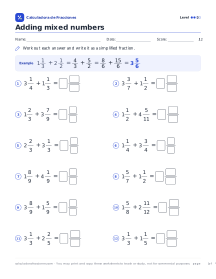
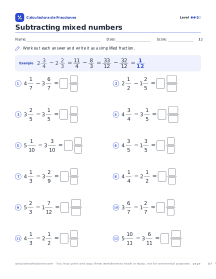
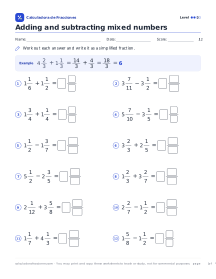
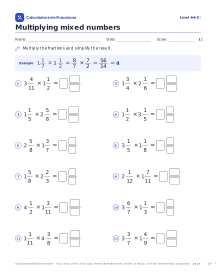
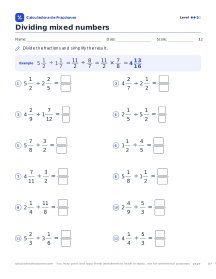
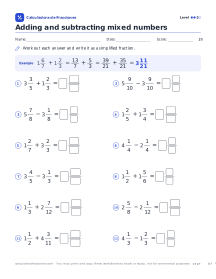
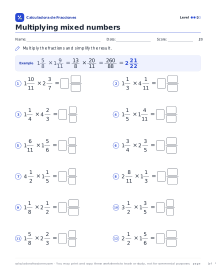
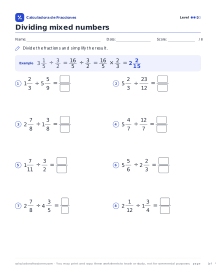
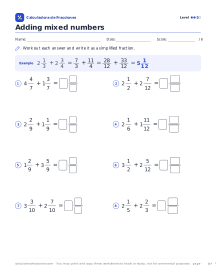
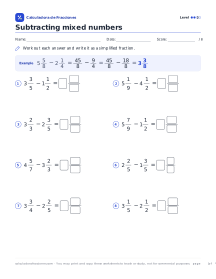
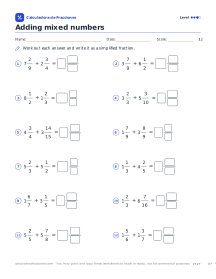
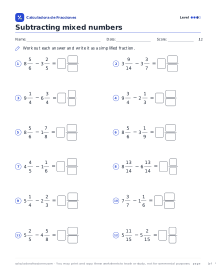
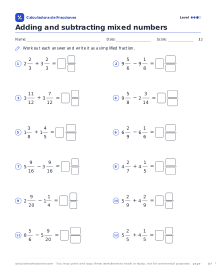
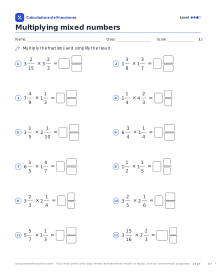
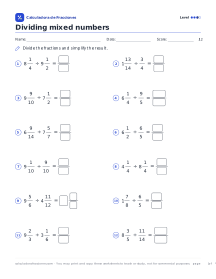
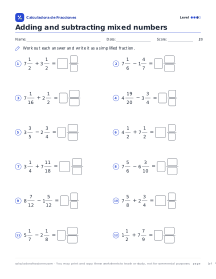
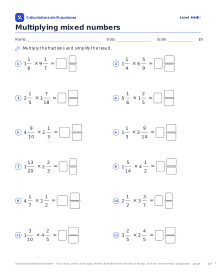
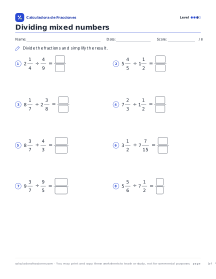
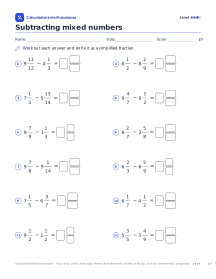
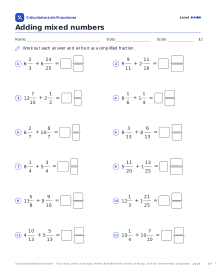
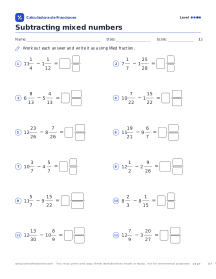
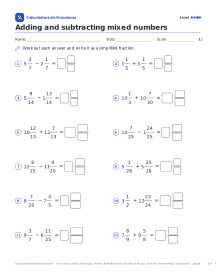
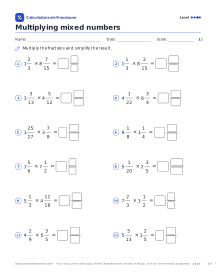
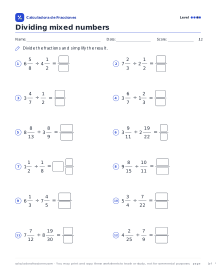
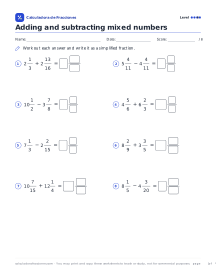
Operating with mixed numbers has one safe path: convert each one into an improper fraction, calculate, and write the result as a mixed number again. This page collects 25 PDF worksheets to practice it, with a separate answer key for each and denominators up to 12, 20 and 30 depending on the level. If all you need is converting, look first at the improper to mixed worksheets.
Which worksheet to choose
The worksheets start at level 2: in level 1 all the fractions are worth less than 1 and there are no mixed numbers. There are 10 worksheets at level 2, 9 at level 3 and 6 at level 4, with 8, 12 or 20 problems. Each one works on one operation, except those that mix addition and subtraction. The table shows what to do in each case and how to leave the answer.
| Operation | Path | Example |
|---|---|---|
| Add | Convert to improper, common denominator, add (or add by parts and regroup) | 2 1/3 + 1 5/6 = 7/3 + 11/6 = 25/6 = 4 1/6 |
| Subtract | The same; avoid subtracting the parts separately | 5 1/3 − 2 3/4 = 16/3 − 11/4 = 31/12 = 2 7/12 |
| Multiply | Convert to improper, numerator by numerator | 1 1/3 × 2 1/4 = 4/3 × 9/4 = 3 |
| Divide | Convert to improper, multiply by the reciprocal | 3 1/3 ÷ 1 2/3 = 10/3 × 3/5 = 2 |
In the table, subtraction is the case that trips students most, which is why there are subtraction worksheets of their own at all three levels. Unless your teacher asks for something else, leave the result as a simplified mixed number and write the improper fraction as an intermediate step. For more problems with other numbers there is the fraction worksheet generator.
A solved problem with addition and subtraction
Test problems with mixed numbers often chain an addition and a subtraction. In this one you add two stretches and subtract the total from the distance of the route.
Worked example: what is left of a route
A route is 4 1/2 miles long. In the morning 1 2/3 miles are covered and in the afternoon 1 3/4 miles. How many miles are left?
- Convert the mixed numbers to improper. 1 2/3 = 5/3 and 1 3/4 = 7/4.
- Add what was covered. The LCM of 3 and 4 is 12, so 5/3 + 7/4 = 20/12 + 21/12 = 41/12.
- Convert the route to twelfths. 4 1/2 = 9/2 = 54/12.
- Subtract. 54/12 − 41/12 = 13/12 = 1 1/12.
Result: 1 1/12 miles are left.
Check: add what is left and what was covered. 13/12 + 41/12 = 54/12 = 4 1/2, the length of the route.
Model answer for the notebook: “1 1/12 mi are left. I added 5/3 and 7/4 as 41/12, converted 4 1/2 to 54/12 and subtracted.” A complete answer names the unit, leaves the operation visible and writes the result as a mixed number.
The mistake of subtracting by parts
In addition, adding by parts works, but it forces you to regroup: in 2 3/8 + 1 7/8 you get 3 and 10/8, and you have to convert 10/8 into 1 2/8 to reach 4 2/8 = 4 1/4. In multiplication and division the shortcut does give a different value: 1 1/3 × 2 1/4 is 3, but multiplying the wholes (1 × 2 = 2) and the fractions (a third times a fourth, 1/12) separately gives 2 1/12.
Practice before printing
- A tank holds 3 2/5 gallons and 1 7/10 gallons are added. How many gallons are in it now?
- From a rope 6 1/4 yards long, 2 5/8 yards are used. How much is left?
- Maria runs 2 1/4 miles and Paul 1 5/6 miles. Who runs farther, and by how much?
- A section of fence is 2 2/5 yards long. How long are 3 1/2 equal sections in a row?
- How many bows of 1 3/4 yards can be cut from a ribbon of 5 1/4 yards?
Show the answers
- 5 1/10 gallons, because 34/10 + 17/10 = 51/10
- 3 5/8 yards, because 50/8 − 21/8 = 29/8
- Maria, by 5/12 mile (27/12 − 22/12)
- 8 2/5 yards, because 12/5 × 7/2 = 84/10 = 42/5
- 3 bows, because 21/4 ÷ 7/4 = 3
For teachers
A 12-problem worksheet takes up one session; the 8-problem ones work as a warm-up or an exit ticket and the 20-problem ones are more comfortable for home. With a mixed group, start with the addition worksheets, where the only new step is regrouping at the end, and let whoever finishes early estimate before calculating: the sum 3 1/6 + 2 4/5 should come out close to 6. For students to check their answers with automatic feedback, there is fraction practice.
If the review of subtraction with different denominators goes wrong, go back to the adding and subtracting fractions worksheets. For a single calculation, the mixed numbers calculator shows the conversion and the result. When all four operations are secure, continue with the order of operations worksheets; the fraction worksheet index gathers the rest of the topics.
Sources
The Wikipedia article Fraction describes a mixed number as an integer plus a proper fraction, says that any improper fraction can be converted to a mixed number and vice versa, and gives the rules for multiplying fractions and dividing by a fraction (consulted October 17, 2026).