
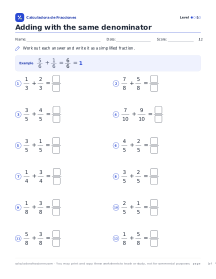
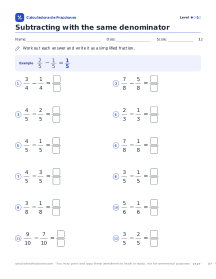
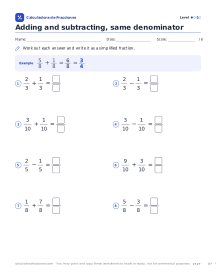
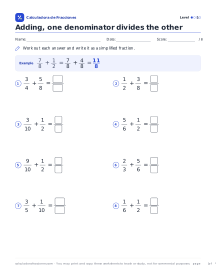
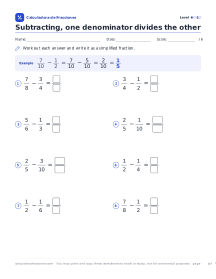
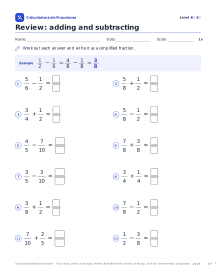
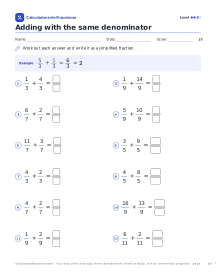
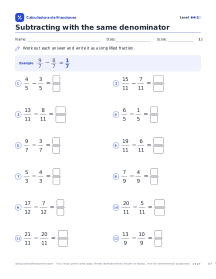
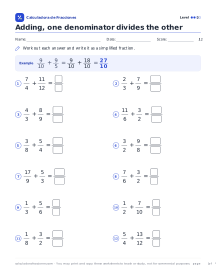
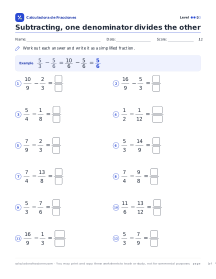
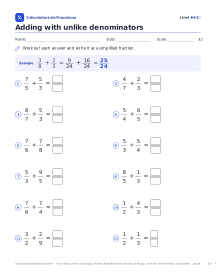
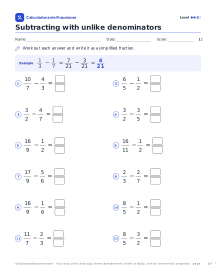
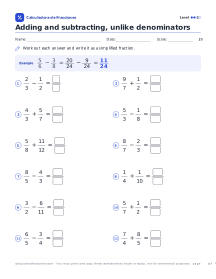
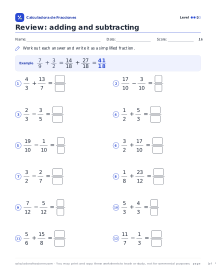
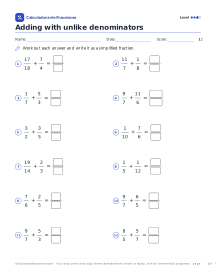
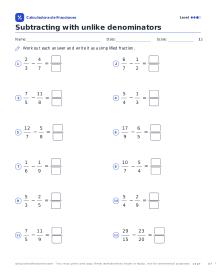
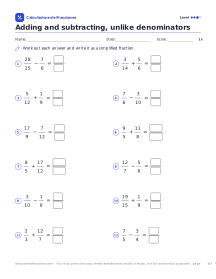
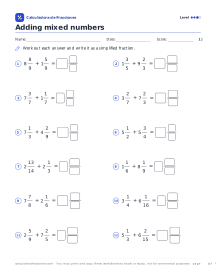
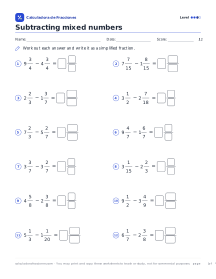
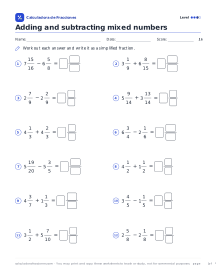
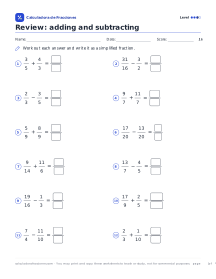
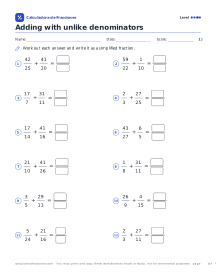
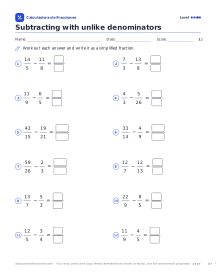
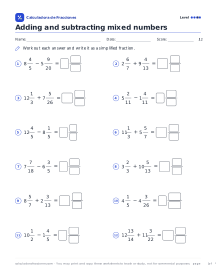
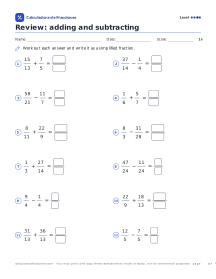
Adding and subtracting fractions is best practiced by case: 4/9 + 2/9 asks for something different from 5/6 − 3/8, and a mixed number adds one more step. This page collects 25 PDF worksheets, each with its own answer key as a separate file, ordered from the simplest case to the longest. If you need to review the method first, there are the pages on adding fractions and subtracting fractions; here you only practice. In the US, this is the Grade 5 skill described in standard 5.NF.A.1 of the Common Core, which asks students to add and subtract fractions with unlike denominators, mixed numbers included, by replacing them with equivalent fractions.
Pick the worksheet for the case
The levels set the size of the denominators, which go up to 10 in level 1, 12 in level 2, 20 in level 3 and 30 in level 4. Depending on the level, worksheets have 8, 12, 16 or 20 problems; most work on a single case, and the review worksheets mix several. The table shows which one to choose depending on what is going wrong.
| If the student struggles with | Example | Worksheets |
|---|---|---|
| Same denominator | 4/9 + 2/9 = 6/9 = 2/3 | Levels 1 and 2: addition and subtraction |
| One denominator is a multiple of the other | 1/3 + 2/9 = 3/9 + 2/9 = 5/9 | Levels 1 and 2: addition and subtraction |
| Different denominators | 5/6 − 3/8 = 20/24 − 9/24 = 11/24 | Levels 2, 3 and 4: addition and subtraction |
| Mixed numbers | 4 1/6 − 1 3/4 = 25/6 − 7/4 = 29/12 = 2 5/12 | Level 3: addition, subtraction and a mix of both; level 4: one worksheet that mixes addition and subtraction |
In the second case you do not need the usual least common denominator: with 1/3 and 2/9 it is enough to rewrite the first fraction in ninths. With 1/6 and 1/4, on the other hand, neither denominator divides the other and the common one is 12. Levels 2, 3 and 4 end with a 16-problem review worksheet that mixes addition and subtraction with equal denominators, multiples and different denominators (without mixed numbers, which have their own worksheets); level 1 closes with a worksheet that mixes equal denominators and multiples. If the review shows the same mistake with one type of denominator, go back to the worksheet for that case; if the student struggles with mixed numbers, the review will not catch it, so go straight to their worksheets.
A multi-step problem, solved
A test-style problem often chains two operations. This one subtracts two amounts in a row from the same total, so the final result is what is left.
Worked example: a ribbon with two cuts
A ribbon is 11/12 of a yard long. A piece of 1/4 yard is cut off, and then another of 1/6 yard. How much is left?
- Find the common denominator of 12, 4 and 6. The least common multiple is 12.
- Convert the pieces. 1/4 = 3/12 and 1/6 = 2/12.
- Subtract in order. 11/12 − 3/12 = 8/12, and 8/12 − 2/12 = 6/12.
- Simplify. 6/12 = 1/2.
Result: 1/2 yard of ribbon is left.
Check: the pieces cut add up to 3/12 + 2/12 = 5/12, and what is left plus what was cut must give the total: 6/12 + 5/12 = 11/12.
Model answer for the notebook: “1/2 yd is left. I changed everything to twelfths, subtracted 3 and 2 from 11, and simplified 6/12.” A complete answer names the unit, leaves the operation visible and simplifies, because that is what gets graded on a worksheet at this level.
The mistake of subtracting and keeping one denominator
Level 3 brings another stumbling block, specific to mixed numbers: subtracting the whole parts and the fraction parts separately. In 3 1/4 − 1 3/4 that forces you to take 3/4 from 1/4, which cannot be done. Converting to improper fractions avoids it: 13/4 − 7/4 = 6/4 = 1 1/2.
Practice before printing
- A tank is filled to 9/10 of its capacity. 1/4 of the capacity is used. What fraction is left?
- I walk 2/3 mile to the park and 3/4 mile from the park home. How many miles do I walk in total?
- Ana has read 7/10 of a book and Luis 5/8 of his, which has the same number of pages. Who has read more, and by how much?
- From a board 2 1/2 feet long, 5/6 foot is cut off. How long is what is left?
Show the answers
- 13/20, because 18/20 − 5/20 = 13/20
- 17/12 miles = 1 5/12 miles
- Ana, by 3/40 of the book (28/40 − 25/40)
- 5/3 feet = 1 2/3 feet, because 15/6 − 5/6 = 10/6 = 5/3
For teachers and parents
A 12-problem worksheet usually fits in a short session; the 8-problem ones work as a warm-up or an exit ticket, and the 20-problem ones tend to be more comfortable for homework. With a mixed group, hand out worksheets for the same case at different levels and let whoever finishes move on to the review of their level. For students to check their answers with automatic feedback, there is fraction practice.
Once both operations are secure, the mixed numbers worksheets go deeper into the last case, and the all four operations ones add multiplying and dividing. The fraction worksheets index gathers all the topics, and the fraction worksheet generator creates a worksheet with other numbers.
Sources
- Common Core State Standards Initiative, Grade 5, Number and Operations in Fractions: standard 5.NF.A.1, add and subtract fractions with unlike denominators, including mixed numbers (consulted October 17, 2026).