
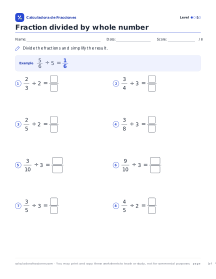
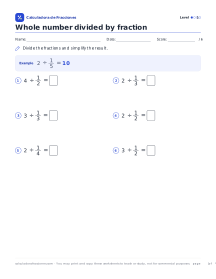
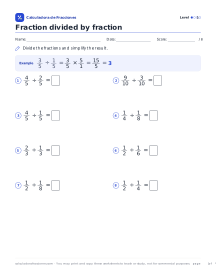
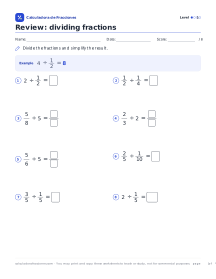
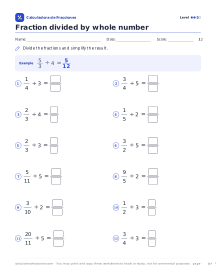
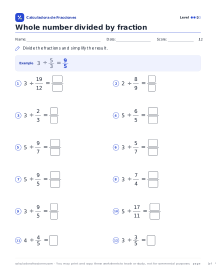
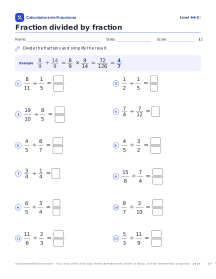
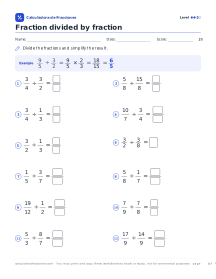
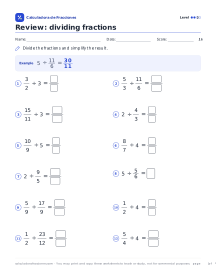
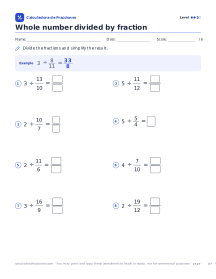
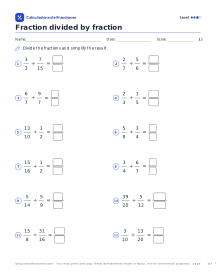
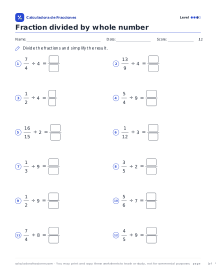
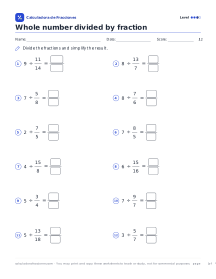
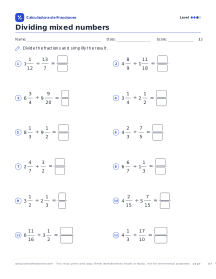
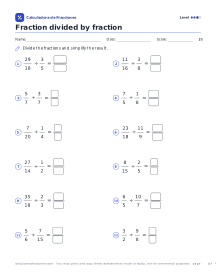
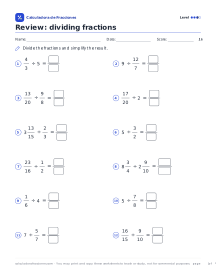
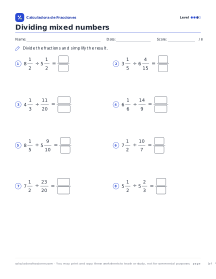
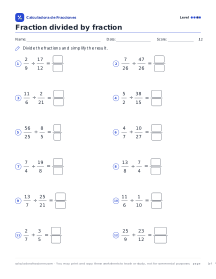
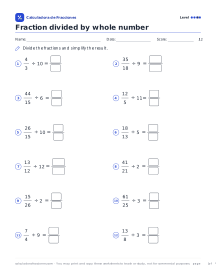
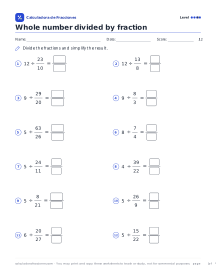
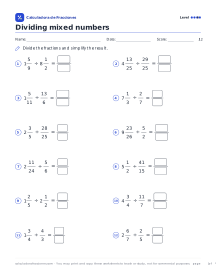
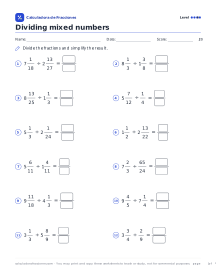
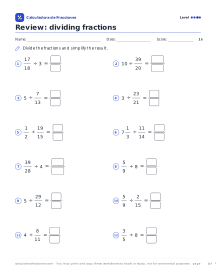
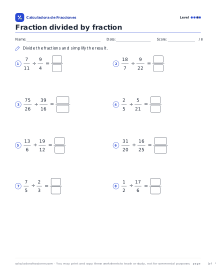
Dividing 3/4 by 1/8 gives 6, because six eighths fit in three fourths. These worksheets, which download as PDFs with a separate answer key, split fraction division into four cases so each can be practiced before they are mixed. If multiplying still goes wrong, review the multiplication worksheets first, because division builds on it. Below you will find a worked example, a test question with its model answer, and the mistakes that come up most.
| Case | Sample problem | What it trains |
|---|---|---|
| Fraction by whole number | 3/7 ÷ 2 = 3/14 | Sharing into equal parts: the whole number multiplies the denominator |
| Whole number by fraction | 6 ÷ 2/5 = 15 | Counting how many times the fraction fits in the whole number |
| Fraction by fraction | 7/9 ÷ 7/18 = 2 | Multiplying by the reciprocal of the divisor and simplifying |
| Mixed numbers | 3 3/5 ÷ 1 4/5 = 2 | Converting to improper fractions before dividing |
Beginners can go from the first case to the second, because sharing is the closest to the idea of division they already know. The third introduces the reciprocal rule, and the fourth only adds the step of converting mixed numbers.
What worksheets there are
The level sets the size of the denominators: up to 10 in level 1, up to 12 in level 2, up to 20 in level 3 and up to 30 in level 4. Mixed numbers appear from level 3. Each level has worksheets by case and a review worksheet that mixes the cases, with 6, 8, 12, 16 or 20 problems depending on the worksheet. The levels measure the size of the numbers and not the grade, so compare them with the standards your school follows.
Worked example: 3/4 ÷ 1/8
A ribbon is 3/4 of a yard long and is cut into pieces of 1/8 yard. How many pieces do you get?
- Set up the question. You are looking for how many times the second fraction fits in the first.
- Flip only the divisor. The reciprocal of 1/8 is 8/1, so you multiply 3/4 × 8/1.
- Multiply. (3 × 8)/(4 × 1) = 24/4.
- Simplify. 24/4 = 6.
Result: you get 6 pieces.
Check: 6 equal pieces add up to 6/8 of a yard, the whole ribbon. Also, the quotient is greater than the dividend because the divisor is less than 1.
Why only the divisor is flipped
What gets flipped is the fraction you divide by, and the order matters. With the same pair of numbers, 1/5 ÷ 2 asks what a fifth looks like when shared into two parts and gives 1/10, while 2 ÷ 1/5 asks how many fifths there are in two wholes and gives 10. If the student only remembers “flip a fraction,” they do not know which one. With the question “how many times does it fit?”, the reciprocal stops being a trick: in each whole there are as many unit divisors as the denominator says; for a/b there are b/a of them, and that is why you multiply by b/a. The guide on why dividing by a fraction can increase develops that idea with groups, and the one on the reciprocal of a fraction explains how to get it.
A test question with mixed numbers
This format appears in level 3: “Calculate 5 1/4 ÷ 2 1/3 and write the result as a mixed number.” A model answer, with the steps a grader usually wants to see:
- Turn each mixed number into an improper fraction: 5 1/4 = (5 × 4 + 1)/4 = 21/4 and 2 1/3 = (2 × 3 + 1)/3 = 7/3.
- Multiply the first by the reciprocal of the second: 21/4 ÷ 7/3 = 21/4 × 3/7 = 63/28.
- Simplify, with GCF 7: 63/28 = 9/4.
- Convert to a mixed number: 9 ÷ 4 is 2 with 1 left over, so 9/4 = 2 1/4.
Estimation works as a control: 5 1/4 is 5.25 and 7/3 is between 2 and 3, so the quotient falls between 5.25 ÷ 3 = 1.75 and 5.25 ÷ 2 = 2.625, and 2 1/4 is inside that range. A result of 12 or 1/12 is ruled out right away. The final answer is written as “2 1/4,” not 9/4, because the question asks for a mixed number, and a student who applies the method correctly but leaves the improper fraction may lose the last point.
The most common mistake
There is an earlier idea that causes other mistakes: thinking that dividing always makes things smaller. With a divisor less than 1 the quotient grows, and with one greater than 1 it shrinks. The level 1 worksheets of whole number by fraction help take that idea apart. A student who stops at each result and compares it with the dividend catches most setup errors.
Five problems with different questions
Each problem asks for something different: sharing, counting how many times it fits, finding the total, comparing and solving two steps. Before calculating, decide what question each one poses. Then compare the result with the starting data to see if it makes sense.
Practice
- 8/9 of a quart of juice is shared among 4 equal glasses. How much is in each glass?
- From a rope 3 yards long, pieces of 3/5 yard are cut. How many pieces do you get?
- A cyclist has ridden 15 miles, which is 3/8 of the route. How long is the whole route?
- A quantity of 7/10 is shared between 2 people and another of 5/6 among 5. Which sharing gives more to each person, and by how much?
- There is 9/10 of a pound of rice. 3/10 of a pound is used and the rest is shared among 3 equal bags. How much rice goes in each bag?
Show the answers
- 2/9 of a quart, because 8/9 ÷ 4 = 8/36 = 2/9.
- 5 pieces, because 3 ÷ 3/5 = 3 × 5/3 = 5.
- 40 miles: each eighth is 15 ÷ 3 = 5 miles, and 5 × 8 = 40.
- The first sharing gives 7/10 ÷ 2 = 7/20 and the second 5/6 ÷ 5 = 1/6, so the first gives more, by 7/20 − 1/6 = 11/60.
- 1/5 of a pound: 9/10 − 3/10 = 3/5 is left, and 3/5 ÷ 3 = 1/5.
For whoever grades
A short session has room for a worksheet of 8 or 12 problems, leaving the 20-problem one as extra practice at home. Before giving the rule, it helps to have the student draw a division with bars to see that the divisor measures how many times one quantity fits in another. In a mixed group, hand out fraction by whole number to whoever is starting and fraction by fraction or mixed numbers to whoever is moving ahead.
When grading, ask the student to write the check multiplication next to each quotient. That tells a method mistake apart from a calculation mistake.
Keep practicing
For a single division there is the divide fractions calculator, which returns the simplified quotient. If the challenge is reading word problems, the division word problem worksheets work on sharing and finding the total. To practice on screen with instant feedback, there is fraction practice, and the worksheet generator creates another sheet with new numbers.
Source consulted: the Wikipedia article Fraction states that to divide a number by a fraction you multiply that number by the reciprocal of that fraction (consulted October 17, 2026).