
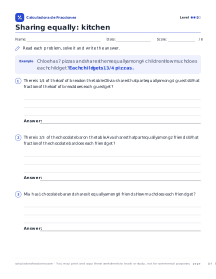
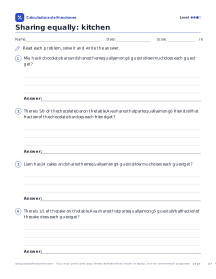
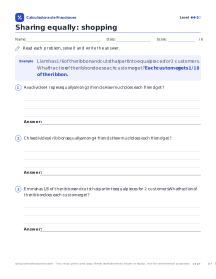
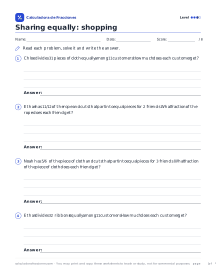
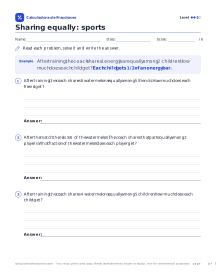
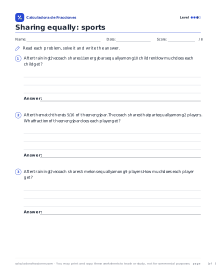
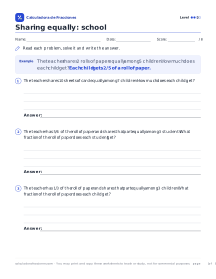
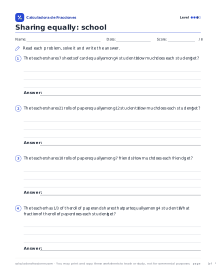
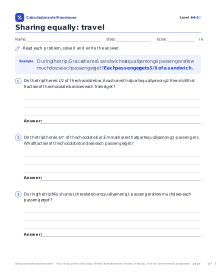
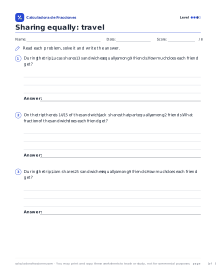
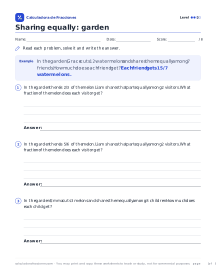
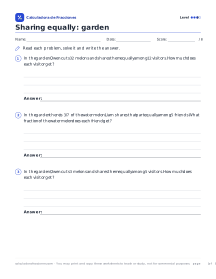
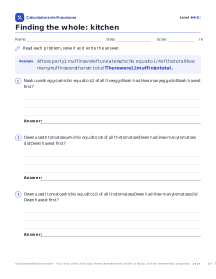
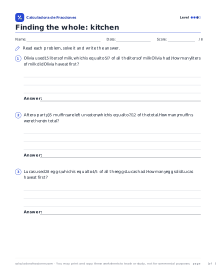
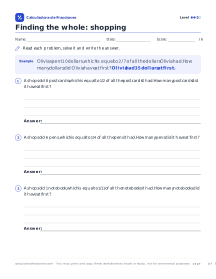
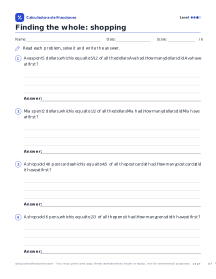
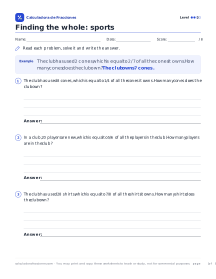
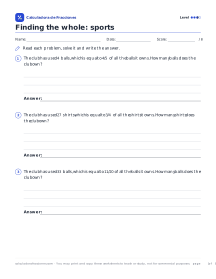
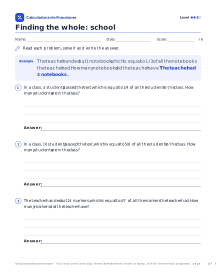
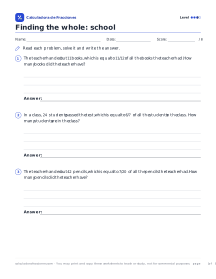
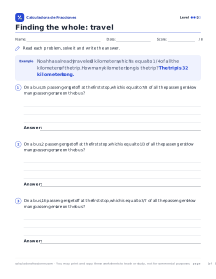
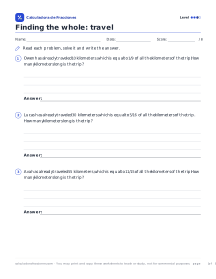
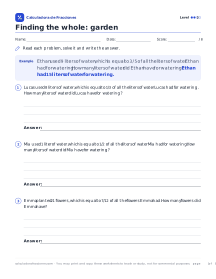
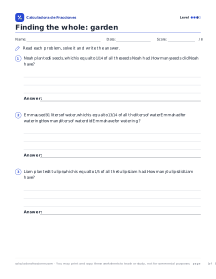
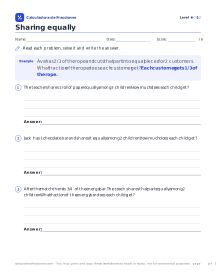
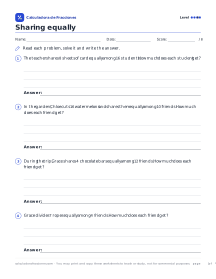
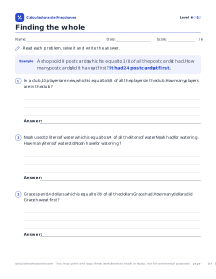
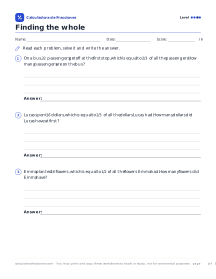
In these problems you divide for one of two reasons: to share a fraction among several people, like 7/8 of a quart among 7 glasses, which gives 1/8 of a quart to each, or to find the whole when you know a part, like 18 pages that are 3/4 of a notebook, where 18 ÷ 3/4 = 24 pages. The 28 worksheets on this page, with 8 problems each, train those two questions, and the model below solves the second one the way it would be solved on a test.
Test problem: the people who signed up for a race
In a charity run, 12 runners have reached the finish line, and they are 3/5 of those who signed up. How many people signed up?
- Identify what the whole is. Those who signed up are the total being looked for, and 12 is a part.
- Work out what each fifth is worth. If 3 fifths are 12 runners, one fifth is 12 ÷ 3 = 4.
- Go to the five fifths. The total is 4 × 5 = 20.
- Write the same thing as a single operation: 12 ÷ 3/5 = 20.
Answer: 20 people signed up.
Check: 3/5 of 20 is 12, the runners who finished. Also, 20 is greater than 12, as it should be: the part never exceeds the whole.
A model answer names the whole and the part: “The 12 runners are 3/5 of those who signed up. Each fifth is worth 4 runners, so the five fifths are 20. 20 people signed up.” A student who writes only “20” does not show whether they know what 12 represents, and one who writes “12 × 3/5” has taken the part for the whole. If the first step is right and the calculation fails, grading can give credit for the setup.
What question each problem asks
The wording tells you whether to divide and why. The table collects the three situations that are mixed in these worksheets, with an example of each.
| Situation | Operation | Example |
|---|---|---|
| A fraction is shared among n | Fraction ÷ n | 2/3 of a pound among 4 bags: 2/3 ÷ 4 = 1/6 of a pound |
| A known part and its fraction; the whole is asked | Part ÷ fraction | 28 is 7/10 of the total: 28 ÷ 7/10 = 40 |
| The whole and the fraction; the part is asked | Multiply, do not divide | 3/4 of 20 = 15 |
The third row serves as a contrast: even though it sounds similar, those worksheets go with the multiplying fractions word problems. Be careful with the order too. In sharing 2/3 among 4 you divide the fraction by the number, and 4 ÷ 2/3 = 6 answers a different question: how many groups of 2/3 fit in 4. A bar model shows which is the whole before you choose.
What worksheets there are
The levels set the size of the denominators: up to 10 in level 1, up to 12 in level 2, up to 20 in level 3 and up to 30 in level 4. In levels 2 and 3 there is one worksheet per setting (cooking, shopping, sports, school, travel and garden), and levels 1 and 4 have one worksheet with mixed settings.
| Level | Sharing worksheets | Find-the-whole worksheets |
|---|---|---|
| 1 | 1 mixed worksheet | 1 mixed worksheet |
| 2 | 6 worksheets, one per setting | 6 worksheets, one per setting |
| 3 | 6 worksheets, one per setting | 6 worksheets, one per setting |
| 4 | 1 mixed worksheet | 1 mixed worksheet |
That makes 28 worksheets in all, each with its answer key. A reasonable path starts with level 1 of each type and moves up to level 2 when the group shares without drawing.
The mistake in this topic: multiplying to find the whole
In level 1 the usual mistake is sharing backward, and from level 2 on this other one appears, which affects the find-the-whole problems. A student who sees a fraction next to a number tends to multiply.
The guide to finding the whole from a fraction calculates this case with other quantities, and the one on the fraction of the remainder covers two-step problems.
Four problems with different questions
Each one asks for something different: sharing, finding the whole, comparing and solving two steps.
Before opening the worksheet
- A cord 5/6 of a yard long is cut into 5 equal pieces. How long is each piece?
- A train has covered 90 miles, which is 2/7 of the trip. How long is the whole trip?
- Ana spends 3/4 of an hour studying three topics equally; Luis spends 4/5 of an hour on two topics equally. Who spends more on each topic, and how much more?
- Fifteen gallons fill 5/8 of a drum. How many more gallons are needed to fill it?
Show the answers
- 1/6 of a yard (5/6 ÷ 5)
- 315 miles (90 ÷ 2 = 45 miles per seventh, and 45 × 7 = 315)
- Luis, by 3/20 of an hour: Ana spends 3/4 ÷ 3 = 1/4 and Luis 4/5 ÷ 2 = 2/5, and 2/5 − 1/4 = 3/20
- 9 gallons: the drum holds 15 ÷ 5/8 = 24 gallons and 24 − 15 are missing
Notes for whoever grades
- Time. As a rough guide, about 20 minutes for a worksheet of 8 problems.
- Differentiate. For a student who freezes on the whole, offer parts of 1/2 and 1/3 before moving on to fifths. For one who finishes early, have them make up a sharing problem using the answer they got on a find-the-whole one.
- Dividing by n is the same as multiplying by 1/n. This is useful when the sharing is among a whole number of people.
- Grade level. The worksheets are not ordered by grade. In the US, Common Core introduces dividing unit fractions by whole numbers in Grade 5 (5.NF.B.7) and word problems dividing fractions by fractions in Grade 6 (6.NS.A.1). Check your state standards for placement.
To practice just the calculation, without a story, there are the dividing fractions worksheets and the divide fractions calculator that shows the procedure. If you prefer that each student corrects their own work, fraction practice does it on screen. The fraction word problems guide gathers the three types and the worksheet generator creates other combinations.
Sources
Common Core State Standards Initiative: Grade 5, Number and Operations in Fractions, standard 5.NF.B.7, apply and extend previous understandings of division to divide unit fractions by whole numbers; and Grade 6, The Number System, standard 6.NS.A.1, interpret and compute quotients of fractions, and solve word problems involving division of fractions by fractions (consulted October 17, 2026). Each state and school decides what is taught in each grade.