
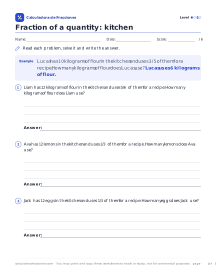
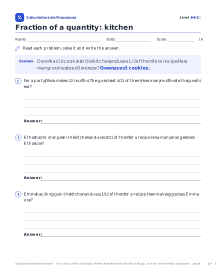
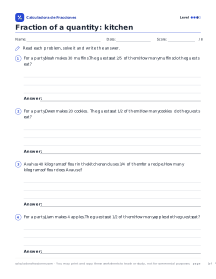
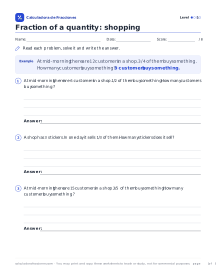
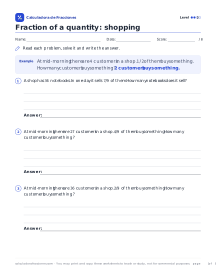
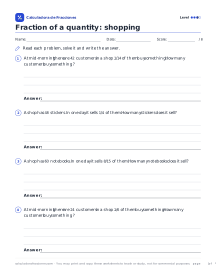
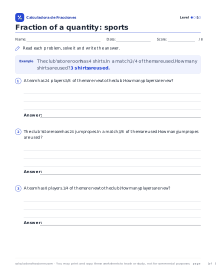
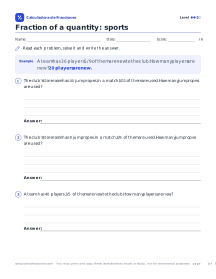
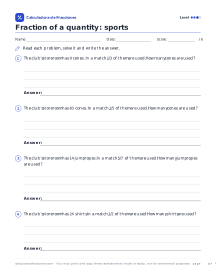
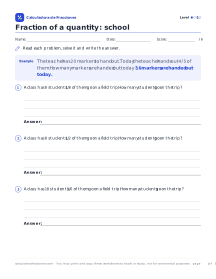
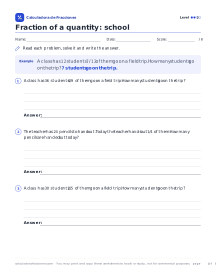
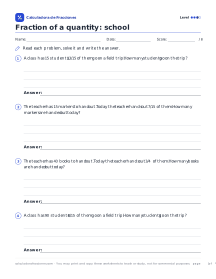
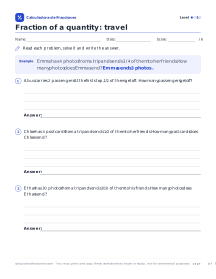
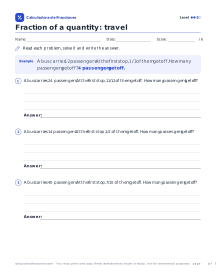
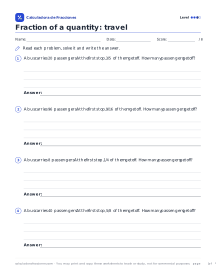
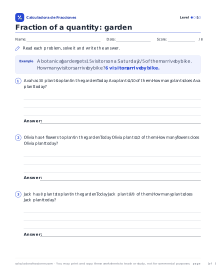
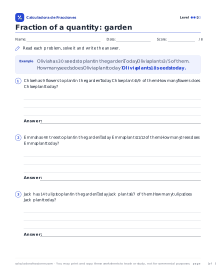
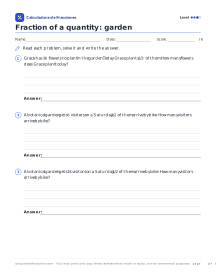
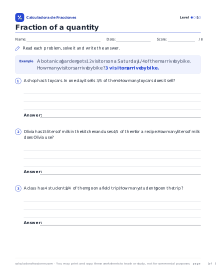
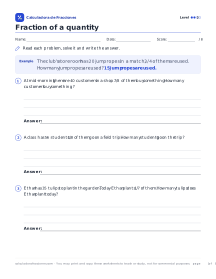
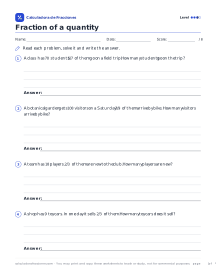
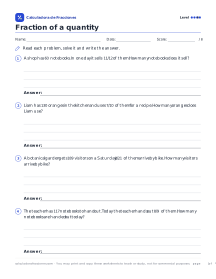
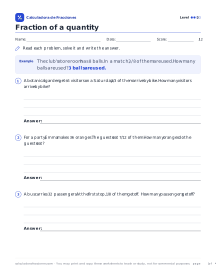
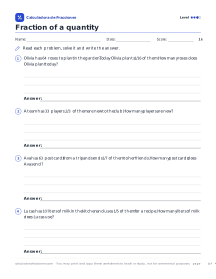
Finding a fraction of a quantity is multiplying: you divide the quantity by the denominator and multiply the result by the numerator. This page collects 24 word problem worksheets to practice it, each with its answer key as a separate file, and a solved test problem to show how a complete answer is written. If the worksheet gives the part and asks for the whole, the work is different: division and sharing word problems.
Test problem: gallons used from a tank
A tank holds 12 gallons of water and 3/4 of it is used. How many gallons have been used?
- Find the total and the fraction. The total is 12 gallons, and the question asks for 3/4 of that amount.
- Divide the total by the denominator. 12 ÷ 4 = 3, so each fourth of the tank is 3 gallons.
- Multiply by the numerator. 3 fourths have been used, and 3 × 3 = 9 gallons.
- Write the answer with the unit.
Answer: 9 gallons have been used.
Check: 9 is less than 12, and more than half, which is 6 gallons, as it should be for a fraction greater than 1/2. Also 12 − 9 = 3 gallons are left, which is exactly one fourth.
A model answer for a test would be: “Each fourth of the tank is 12 ÷ 4 = 3 gallons. The 3/4 are 3 × 3 = 9 gallons, so 9 gallons have been used.” Writing only “9” leaves the reasoning out of sight, and grading by steps has nothing to score. If the student makes a mistake in the division but multiplies correctly with that value, grading by steps allows you to recognize what they did do.
What the problem asks
The problems on the worksheets always ask for the part. The other three types in the table appear on other pages and on tests, and it helps to tell them apart so you do not apply the same operation to all of them.
| Type | What you do | Example |
|---|---|---|
| Find the part | Divide by the denominator and multiply by the numerator | A crew paints 2/5 of a 35-foot fence: 35 ÷ 5 × 2 = 14 feet |
| Find the whole | Divide the part by the fraction | 18 members are 3/7 of the club: 18 ÷ 3/7 = 18 × 7/3 = 42 members |
| Compare | Calculate each part and see which is greater | Ana reads 2/3 of 30 pages, that is 20, and Ben 3/5 of 35, that is 21: Ben reads more |
| Several steps | Calculate the first part, subtract it and apply the second fraction to the rest | Of 60 plants, 1/3 are watered (20) and then 1/4 of those left: 1/4 of 40 = 10 plants |
The row for the whole goes from multiplying to dividing, and it is the one that confuses most on a test that mixes types. To practice it there are division and sharing word problems. A bar model helps you decide: if the whole bar is what you know, you multiply, and if what you know is one of its parts, you divide. Multi-step problems are covered in the guide to the fraction of the remainder and in the adding and subtracting word problems.
What worksheets there are
The problems are set in cooking, shopping, sports, school, travel and the garden. The level sets the size of the denominators: up to 10 in level 1, up to 12 in level 2, up to 20 in level 3 and up to 30 in level 4.
| Type of worksheet | Levels | Problems per worksheet | Worksheets |
|---|---|---|---|
| Single setting | 1, 2 and 3 | 8 | 18 |
| Mixed settings | 1, 2, 3 and 4 | 8 | 4 |
| Mixed, longer | 2 and 3 | 12 and 16 | 2 |
To start, a single-setting worksheet at level 1 lets you concentrate on the method. The mixed-setting ones come after, to change the situation without changing the method.
Divide by the denominator, not by the numerator
The mistake shows up mostly when the rule is memorized without drawing the bar.
Four problems to try
These four ask for different things: a part, what has not been done, two steps in a row and the whole.
Before opening the worksheet
- A bike route is 48 miles long and Marta has done 5/8 of it. How many miles has she covered?
- A team plays 36 games and wins 5/9 of them. In how many games has it not won?
- An 80-gallon tank is filled to 3/5. 1/4 of what it holds is drained. How many gallons are left?
- Julia has read 21 pages, which are 3/8 of her book. How many pages does the book have?
Show the answers
- 30 miles (48 ÷ 8 × 5)
- In 16 games: it wins 36 ÷ 9 × 5 = 20, and 36 − 20 = 16. It is also 4/9 of 36 = 16
- 36 gallons: it holds 80 ÷ 5 × 3 = 48, 48 ÷ 4 = 12 are drained, and 48 − 12 = 36
- 56 pages: 21 ÷ 3 × 8 = 56, which matches 21 ÷ 3/8
Notes for whoever grades
- A worksheet of 8 problems takes roughly 15 to 25 minutes, because each problem asks the student to read, draw and write the answer.
- For a student who freezes, give the bar already divided into parts. For one who finishes early, ask them to solve the same problem two ways, dividing first or multiplying first.
- Before calculating, have the group say between which two numbers the answer has to fall.
- In the US, Common Core covers solving word problems that multiply a fraction by a whole number in Grade 4 (4.NF.B.4.c) and real-world problems with fractions and mixed numbers in Grade 5 (5.NF.B.6). The worksheets are not ordered by grade, and each state and school decides how to place them.
To train the calculation without a story, there are the fraction of a number worksheets and, to check a result, the fraction of a number calculator or the multiply fractions one. If the data is the part and the whole is asked for, see the division and sharing word problems and the find the whole from a fraction tool. For each student to correct themselves on screen, fraction practice does it with immediate feedback. The adding and subtracting word problems work on what is left, and the worksheet generator creates other combinations. The fraction word problems guide gathers the three types.
Sources
Common Core State Standards Initiative: Grade 4, Number and Operations in Fractions, standard 4.NF.B.4, apply and extend previous understandings of multiplication to multiply a fraction by a whole number, including word problems (4.NF.B.4.c); and Grade 5, Number and Operations in Fractions, standard 5.NF.B.6, solve real world problems involving multiplication of fractions and mixed numbers (consulted October 17, 2026).