
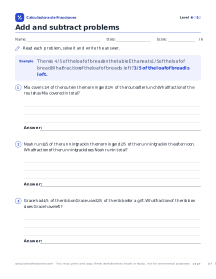
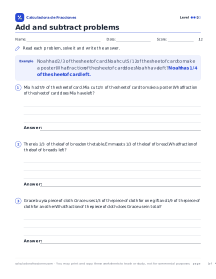
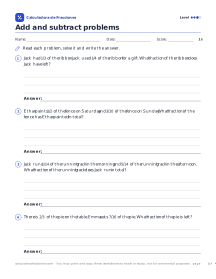
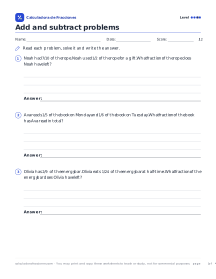
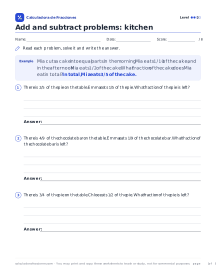
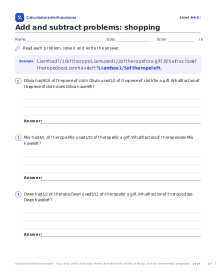
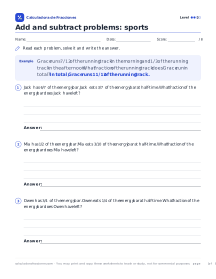
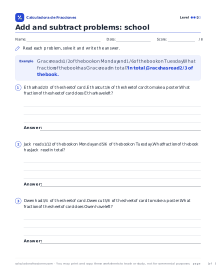
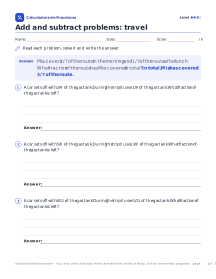
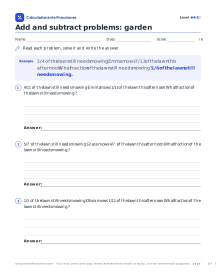
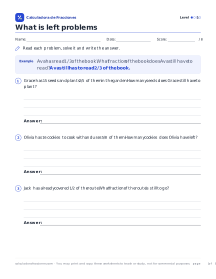
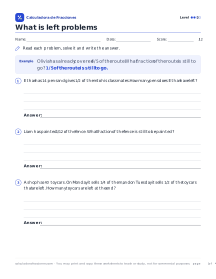
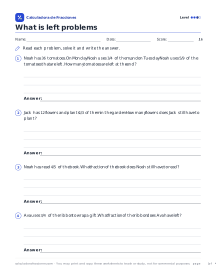
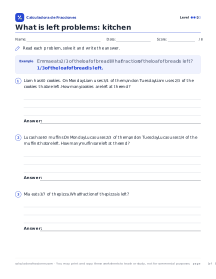
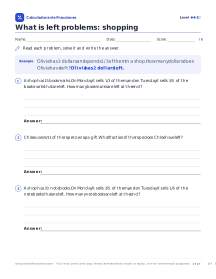
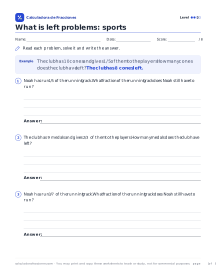
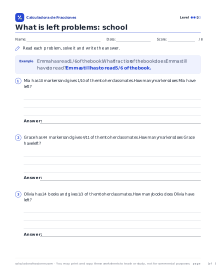
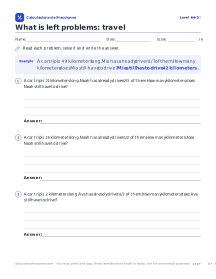
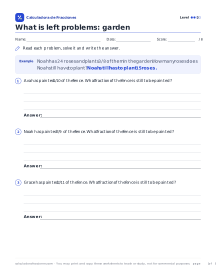
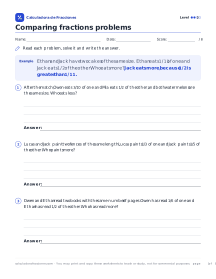
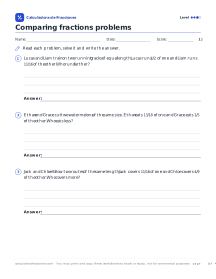
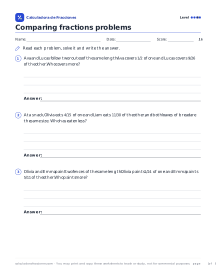
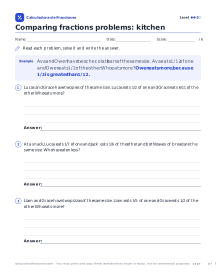
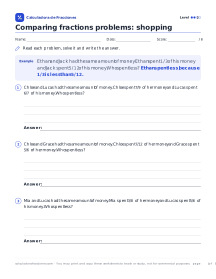
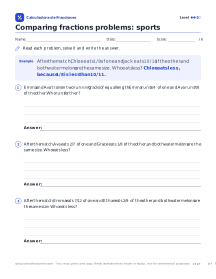
The worksheets on this page gather problems of three types: putting parts together, finding what is left and comparing two quantities. There are 25 worksheets of 8, 12 or 16 problems, each with its answer key as a separate file. For bare operations, without a story, there are the adding and subtracting fractions worksheets; here each worksheet starts from a situation. The model below adds two waterings of a garden with different denominators.
Test problem: two waterings in a garden
A gardener waters 1/3 of the garden in the morning and 1/4 in the afternoon. What fraction of the garden has been watered in total?
- Look at the whole. Both fractions are parts of the same garden, so they can be put together.
- Find the common denominator. The least common multiple (LCM) of 3 and 4 is 12.
- Convert each part to twelfths: 1/3 = 4/12 and 1/4 = 3/12.
- Add the numerators and keep the denominator: 4/12 + 3/12 = 7/12.
Answer: 7/12 of the garden has been watered.
Check: 1/3 ≈ 0.333 and 1/4 = 0.25, which add up to ≈ 0.583 (error less than 0.001), the same as 7/12 = 0.58333... Also 7/12 is less than 1, so there is still garden left to water.
A model answer names what was calculated: “Both parts are of the same garden; in twelfths they add up to 4 + 3 = 7, so the gardener has watered seven twelfths.” Writing only the result does not show whether the quantity was understood.
Which operation the problem asks for
The question in the problem tells you the operation.
| If the problem asks | Operation | Example |
|---|---|---|
| How much is there in total? | Add the parts | 1/2 + 2/5 = 5/10 + 4/10 = 9/10 |
| How much is left? | Subtract what was used from 1 | 1 − 3/10 = 10/10 − 3/10 = 7/10 |
| Who has more? | Compare with a common denominator | 3/5 = 21/35 and 4/7 = 20/35, so 3/5 > 4/7 |
| How much more? | Subtract the smaller from the greater | 3/5 − 4/7 = 21/35 − 20/35 = 1/35 |
When the known data is a quantity and not a fraction, as in “44 pages are left,” the problem has one more step: first you find the fraction that quantity represents and then the total. A bar model helps you see the whole.
What worksheets there are
There are three families, with worksheets of mixed settings and worksheets of a single setting (cooking, shopping, sports, school, travel and garden; comparing has only the first three). The level sets the denominators: up to 10, 12, 20 and 30 in levels 1 to 4. Adding and subtracting is the family with the most worksheets, 10 in all, against 9 for what is left and 6 for comparing.
| Family | Mixed settings | Single setting, level 2 |
|---|---|---|
| Adding and subtracting | Level 1: 8, level 2: 12, level 3: 16, level 4: 12 | 6 worksheets of 8 |
| What is left | Level 1: 8, level 2: 12, level 3: 16 | 6 worksheets of 8 |
| Comparing | Level 2: 8, level 3: 12, level 4: 16 | 3 worksheets of 8 |
The table reads by rows: each family goes up a level with more problems per worksheet, and the single-setting worksheets are for practicing one situation before mixing them.
The mistake in this topic: subtracting two fractions in a row
Four problems with different questions
Each problem asks for something different: a sum, a remainder, a comparison and a total from a part.
Before opening the worksheet
- Lucy walks 3/8 of a mile to the park and 1/4 of a mile to the store. How far does she walk in total?
- A pool is filled to 7/8 of its capacity. 1/6 of its capacity is drained to clean it. What fraction of the pool still has water?
- Two identical bottles hold 5/6 and 7/9 of juice. Which has more, and by how much?
- A book is read 2/9 on Saturday and 1/6 on Sunday, and 44 pages are left. How many pages does the book have?
Show the answers
- 5/8 of a mile (3/8 + 2/8)
- 17/24 of the pool (21/24 − 4/24)
- The one with 5/6, by 1/18 (15/18 − 14/18)
- 72 pages: 2/9 + 1/6 = 7/18 have been read, 11/18 are left, and 44 ÷ 11/18 = 72
Notes for whoever grades
- Differentiate. For a student who gets stuck reading, ask them to tell the situation in their own words before calculating.
- Grade level. The worksheets are not ordered by grade. In the US, Common Core covers word problems with like denominators in Grade 4 (4.NF.B.3.d) and with unlike denominators in Grade 5 (5.NF.A.2); in these worksheets levels 2 to 4 can include improper fractions and levels 3 and 4 go past denominator 12. Check your state standards for your grade.
If you prefer that each student corrects their own work, fraction practice does it on screen. To check a result, the add and subtract fractions calculators show the common denominator. The fraction word problems guide gathers the three types with more examples.
Sources
Common Core State Standards Initiative: Grade 4, Number and Operations in Fractions, standard 4.NF.B.3.d, solve word problems involving addition and subtraction of fractions referring to the same whole and having like denominators; and Grade 5, Number and Operations in Fractions, standard 5.NF.A.2, solve word problems involving addition and subtraction of fractions referring to the same whole (consulted October 17, 2026). Each state and school decides what is taught in each grade.