
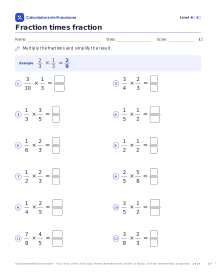
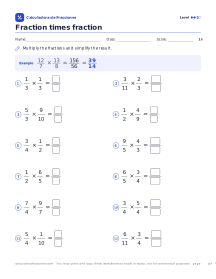
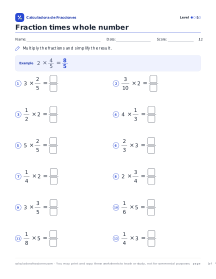
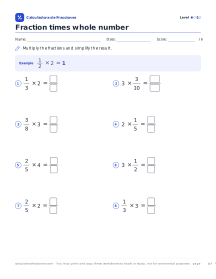
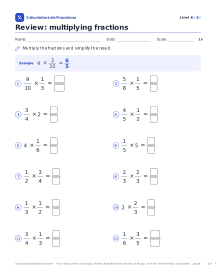
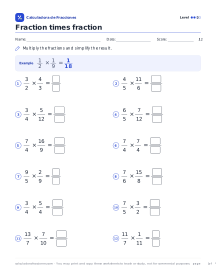
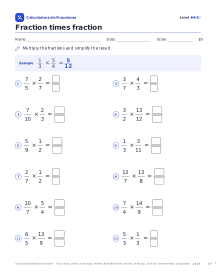
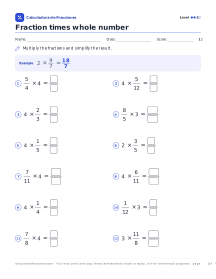
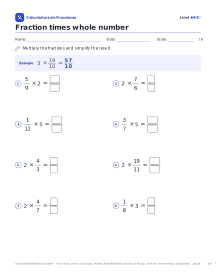
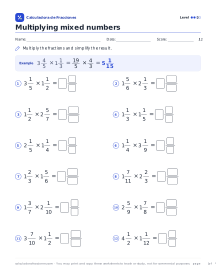
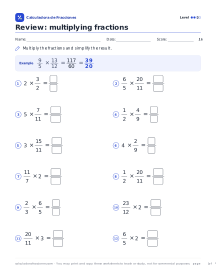
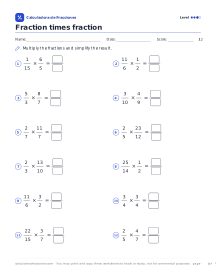
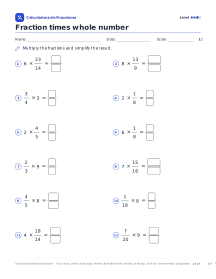
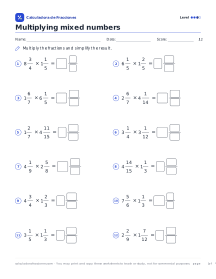
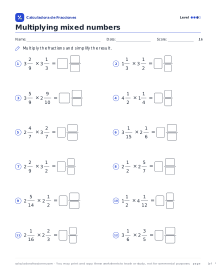
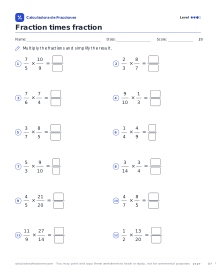
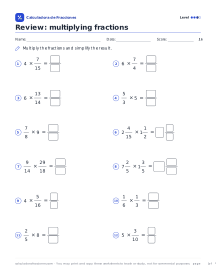
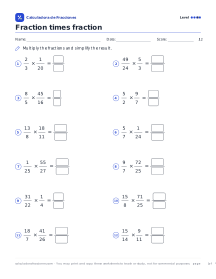
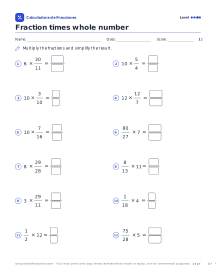
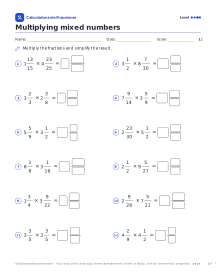
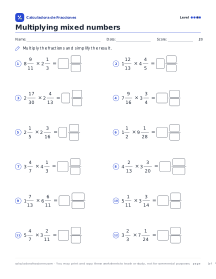
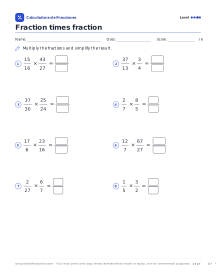
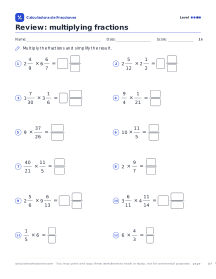
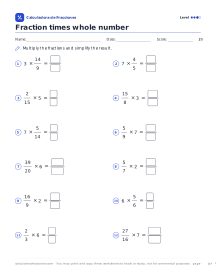
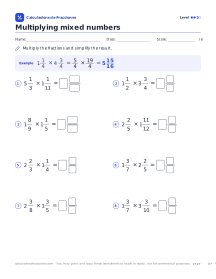
The 25 worksheets on this page download as PDFs, each with its own answer key as a separate file. They organize the work into three kinds of product and four levels of number size, and in every one the result is left simplified.
| If the student… | Start with | Sample problem |
|---|---|---|
| has just seen what it means to multiply a fraction | Level 1, fraction times whole number (8 or 12 problems) | 5/6 × 3 |
| already multiplies by a whole number | Level 1 or 2, fraction times fraction | 2/5 × 3/4 |
| has the procedure down but slips when simplifying | Level 3 or 4, 20-problem worksheets | denominators up to 20 or 30 |
| works with mixed numbers | Levels 2 to 4, "mixed" type | 1 1/4 × 1 1/3 |
The level sets the size of the denominators: up to 10 in level 1, up to 12 in level 2, up to 20 in level 3 and up to 30 in level 4. Mixed numbers start in level 2, and each level ends with a 16-problem review worksheet that mixes the types.
Worked example: 6/35 × 14/15
A piece of ribbon is 14/15 of a yard long, and 6/35 of that piece is used. What fraction of a yard is the part used?
- Write the product. Multiply numerator by numerator and denominator by denominator: (6 × 14)/(35 × 15) = 84/525.
- Find the common factor. The GCF of 84 and 525 is 21.
- Divide top and bottom by 21. 84/525 = 4/25.
- Another way, canceling first. 6 and 15 share the factor 3, and 14 and 35 share 7. That leaves (2 × 2)/(5 × 5) = 4/25, without big numbers.
Result: 4/25 of a yard.
Check: 6/35 is almost 0.17 and 14/15 is almost 0.93. The product should come out a little below 0.17, and 4/25 = 0.16.
With a calculator at hand, the student can check the result on multiply fractions, which simplifies the product the way each answer key does.
A test question, solved the way it is graded
This format shows up in levels 2 and 3: “Calculate 2 2/5 × 1 7/8 and write the result as a mixed number.” A model answer, with the steps a grader usually wants to see:
- Turn each mixed number into an improper fraction: 2 2/5 = (2 × 5 + 2)/5 = 12/5 and 1 7/8 = (1 × 8 + 7)/8 = 15/8.
- Multiply: 12/5 × 15/8 = 180/40.
- Simplify, with GCF 20: 180/40 = 9/2.
- Convert to a mixed number: 9 ÷ 2 is 4 with 1 left over, so 9/2 = 4 1/2.
Estimation works as a control: 2 2/5 is almost 2.4 and 1 7/8 almost 1.9, and 2.4 × 1.9 is about 4.6, close to 4.5. A result of 2 or 9 is ruled out right away.
Word problems
A worksheet with nothing but bare products does not teach when to multiply. These five word problems change the question: the part, the whole, a comparison and several steps.
Practice
- A book has 40 pages and you have already read 5/8. How many pages did you read?
- 3/8 of a hiking trail is 12 miles. How long is the whole trail? Check your answer by multiplying.
- Which is greater, 3/4 of 4/9 or 3/8 of 5/6?
- A tank is filled to 3/5. 5/6 of that content is used. What fraction of the tank is left?
- Calculate 7/6 × 3/14, canceling before multiplying.
Show the answers
- 25 pages, because 5/8 × 40 = 200/8 = 25.
- 32 miles. Working backward: 3/8 × 32 = 96/8 = 12 miles, which matches the given amount.
- 3/4 of 4/9 is greater: 3/4 × 4/9 = 1/3 and 3/8 × 5/6 = 5/16, and 1/3 is more than 5/16 (16/48 against 15/48).
- 3/5 × 5/6 = 1/2 of the tank was used, so 3/5 − 1/2 = 1/10 is left.
- 1/4. Cancel the 7 with the 14 and the 3 with the 6, which leaves 1/(2 × 2).
Where most students go wrong
Two other mistakes show up constantly. The first is looking for a common denominator, as in addition: 1/4 × 1/5 does not need to be changed to denominator 20; you multiply the denominators and get 1/20. The second is working separately with the wholes and fractions in a mixed number: 3 1/3 × 1 1/5 is not 3 1/15, but 10/3 × 6/5 = 60/15 = 4.
There is a false idea worth taking apart with a level 1 worksheet: multiplying does not always make a number bigger. With a proper fraction the product is smaller than the other factor, and 3/7 × 5/6 = 5/14 shows it. This is the idea of multiplication as scaling in Common Core standard 5.NF.B.5.
For whoever grades
A 12-problem worksheet fits in a short session. The 8-problem ones work as a warm-up or exit ticket and the 20-problem ones as extra practice at home. For a mixed group, hand out fraction times whole number to whoever is starting, and fraction times fraction or mixed numbers to whoever is moving ahead.
When grading, ask each student to mark on the sheet which factors they canceled. That shows whether the mistake is in the procedure or in the multiplication table. The age for each level is not fixed, because the levels measure the size of the numbers and not the grade; compare them with the standards your school follows.
Keep practicing
For a single product there is the multiply fractions calculator. When the problem asks for a part of an amount, as in the first one above, fraction of a number explains the setup. The division worksheets work on the inverse operation, with their own examples and mistakes. To practice on screen with instant feedback, there is fraction practice, and the worksheet generator creates another sheet with new numbers.
Source consulted: the Common Core State Standards Initiative page Grade 5, Number and Operations in Fractions lists 5.NF.B.4, multiply a fraction or whole number by a fraction; 5.NF.B.5, interpret multiplication as scaling; and 5.NF.B.6, solve real world problems involving multiplication of fractions and mixed numbers (consulted October 17, 2026).