
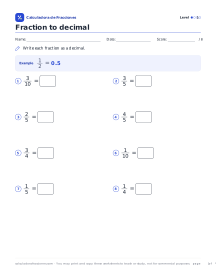
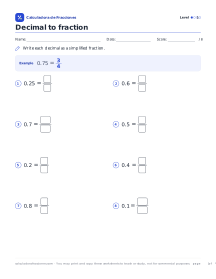
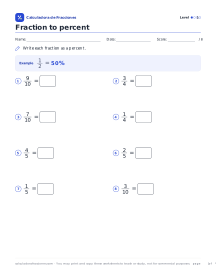
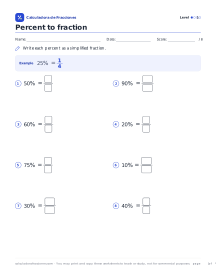
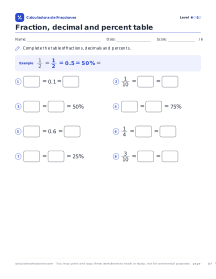
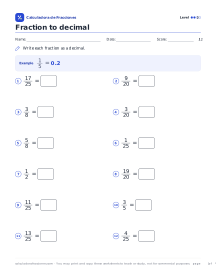
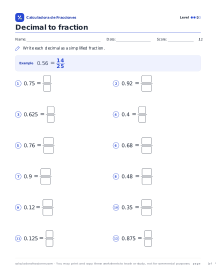
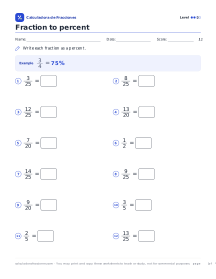
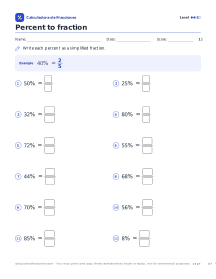
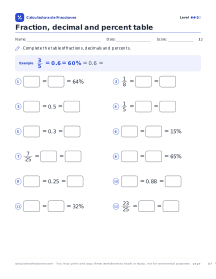
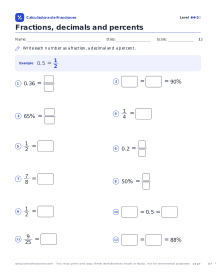
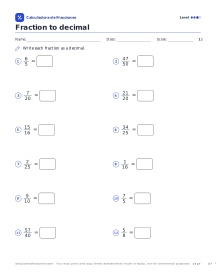
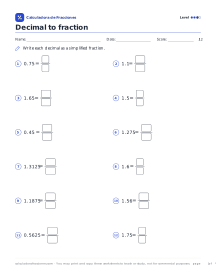
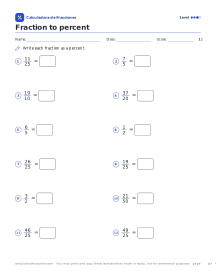
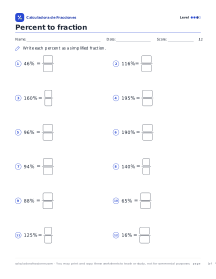
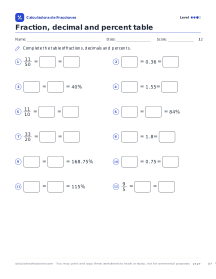
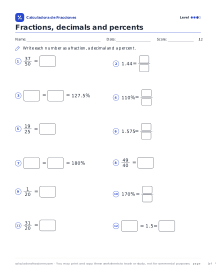
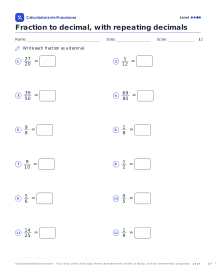
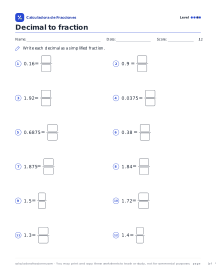
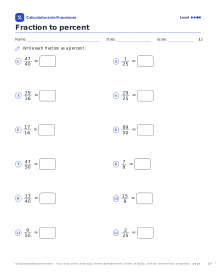
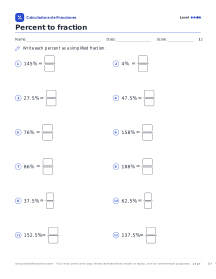
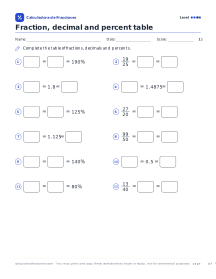
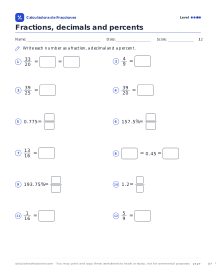
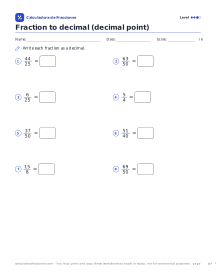
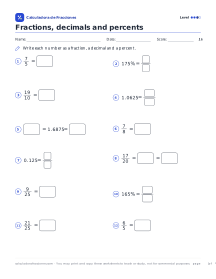
To turn 3/4 into a decimal, divide 3 by 4 and you get 0.75; to turn it into a percent, multiply by 100 and you get 75%. These 25 PDF worksheets practice that path and the reverse, with three-column tables, mixed worksheets and, in level 4, fractions that give repeating decimals. Each worksheet has its own answer key as a separate file.
On these worksheets decimals are written with a point, as in the US: 0.75.
Three forms of the same number
A fraction, a decimal and a percent are three ways of writing the same value. The table marks which ones are exact and which are rounded.
| Fraction | Decimal | Percent | Type |
|---|---|---|---|
| 3/4 | 0.75 | 75% | Exact |
| 1/8 | 0.125 | 12.5% | Exact |
| 1/20 | 0.05 | 5% | Exact |
| 1/3 | 0.(3) ≈ 0.333 | ≈ 33.3% | Repeating: rounded |
The first row of the table is the model for the worksheets in levels 1 to 3, and the last one for those in level 4. In 1/3 the 3 repeats forever, so 0.333 and 33.3% are approximations and are written with ≈.
Worked example: who did better on the quiz?
On a quiz of 40 questions, Dan got 34 right and Eve got 7/8 of the questions right. Who had the better result, and by how many percentage points?
- Turn both results into percents. Dan: 34/40 = 0.85 = 85%.
- Do the same for Eve. 7/8 = 7 ÷ 8 = 0.875, and 0.875 × 100 = 87.5%.
- Compare. 87.5% is greater than 85%.
- Subtract. 87.5 − 85 = 2.5 percentage points.
Result: Eve, with 87.5% against 85%, by 2.5 points.
Check: 7/8 of 40 is 35 questions, one more than Dan's 34, and 1/40 = 0.025 = 2.5%.
This is a level 3 task: two different forms that have to be brought to a single one in order to compare. A complete model answer, like the one a mixed worksheet asks for, writes the two conversions, the comparison and a sentence with the unit: “Eve got more right: 87.5% against 85%.”
What is in the 25 worksheets
There are five types of worksheet: fraction to decimal, decimal to fraction, fraction to percent, percent to fraction and a three-column table. Levels 2 to 4 add a mixed worksheet that shuffles the five types.
- Level 1 (5 worksheets of 8 problems): one type per worksheet and a table.
- Level 2 (6 worksheets of 12 problems): the same types and the first mixed worksheet.
- Level 3 (8 worksheets): six of 12 problems, one of 16 mixed problems and one of 8 problems.
- Level 4 (6 worksheets of 12 problems): includes the fraction to decimal worksheet with repeating decimals.
One possible path starts with the type that costs the most, continues with the table and ends with a mixed worksheet. To generate other sets, use the fraction worksheet generator. The most used equivalences are gathered in the fraction, decimal and percent table.
Where most students go wrong
The typical mistake is turning the decimal into a fraction without looking at how many digits come after the point.
Two other mistakes come up often. The first is forgetting the × 100: 3/5 = 0.6, and 0.6 is not 0.6%, but 60%. The second is cutting off a repeating decimal: 1/3 is not 0.3, which equals 3/10 and is less than 1/3.
Four problems before printing
- A 40-gallon tank is filled to 3/8. How many gallons does it hold?
- In a group, 18 people are 45% of the total. How many people are in the group?
- Which is greater, 5/6 or 0.8?
- Of a 250-page book, Lia read 0.4 on Monday and 1/5 on Tuesday. What percent is left to read, and how many pages is that?
Show the answers
- 15 gallons (40 ÷ 8 = 5, and 5 × 3 = 15)
- 40 people (45% = 9/20, so 18 is 9 parts of 20; 18 ÷ 9 = 2 and 2 × 20 = 40)
- 5/6 = 0.8333…, which is greater than 0.8
- 0.4 + 1/5 = 0.4 + 0.2 = 0.6, so 40% is left, which is 100 pages
For teachers
A student who hesitates with division can stay with the denominators that give short decimals before moving to level 4. For checking at home, the fraction to decimal, decimal to fraction and fraction to percent calculators give the result to compare with. If you want all the conversions together, they are in conversions, and for students to correct themselves there are problems with automatic feedback in fraction practice. To take percents into word problems, continue with fraction of a number.
Sources
- Wikipedia, Percentage: defines a percentage as a number or ratio expressed as a fraction of 100, and shows 45% equal to the fraction 45/100, or 0.45 (consulted October 17, 2026).