
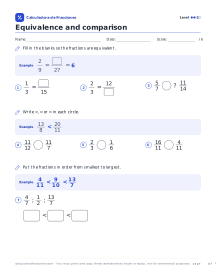
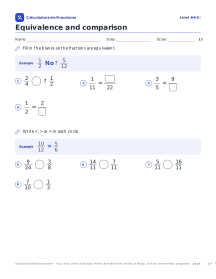
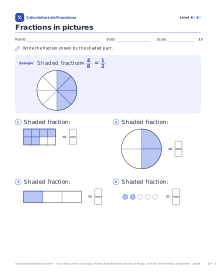
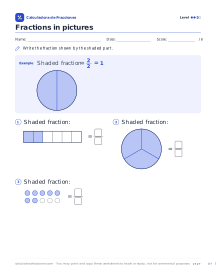
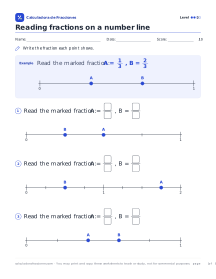
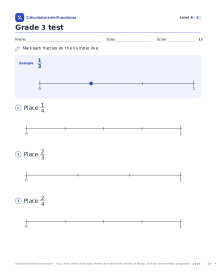
Third grade is where fractions become numbers: students place them on a number line, find equivalent fractions and compare them. These worksheets, at levels 1 and 2, follow that sequence, and the last one is an 18-problem test. Every sheet has a separate answer key.
What this grade practices
The Common Core fractions domain for grade 3 has three standards in cluster A:
| Standard | What students do | Example |
|---|---|---|
| 3.NF.A.1 | Understand 1/b as one of b equal parts, and a/b as a parts of size 1/b | 3/4 is three parts of size 1/4 |
| 3.NF.A.2 | Place fractions on a number line | 3/4 is three jumps of 1/4 from 0 |
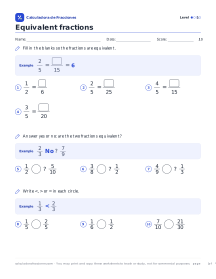
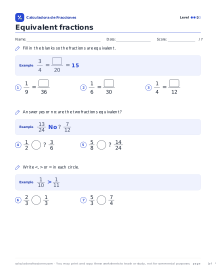
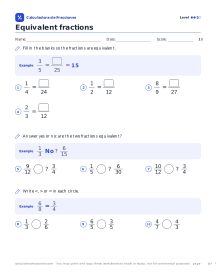
| 3.NF.A.3 | Find equivalent fractions and compare fractions with the same numerator or denominator | 2/4 = 1/2; 3/8 < 3/4 |
3.NF.A.3.c also asks students to write whole numbers as fractions, such as 6/3 = 2. The Common Core limits 3rd grade to denominators 2, 3, 4, 6 and 8, while level 1 here also uses 5 and 10, and level 2 uses denominators up to 12. Equivalence items can go further (up to 30 at level 1 and 36 at level 2), for example 1/3 = 3/9. Treat level 2 as extension or as preparation for 4th grade.
How to use these worksheets
The library has seven topics, and each has a level 1 sheet of 10 problems and two level 2 sheets (7 or 8 problems, and 10). The sequence that matches the standards:
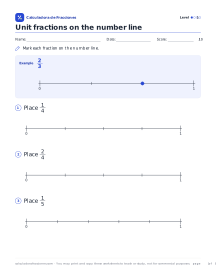
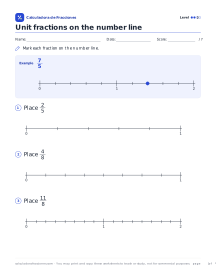
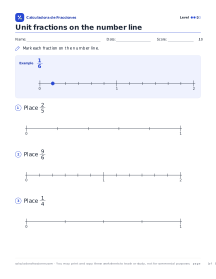
- Unit fractions on the number line. Count the equal spaces first, then place 1/b, and later any fraction a/b.
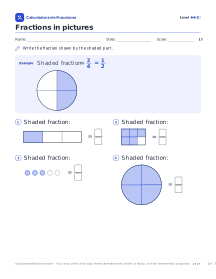
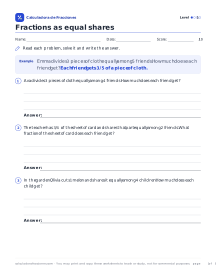
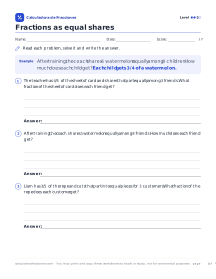
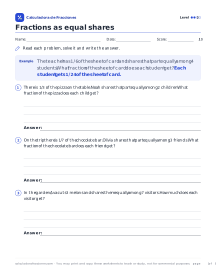
- Fractions in pictures and equal shares. This connects 3.NF.A.1 to sharing problems.
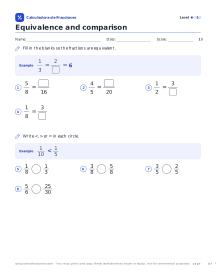
- Equivalent fractions. Fill in a missing numerator and use the number line to see that 1/2 and 2/4 are the same point.
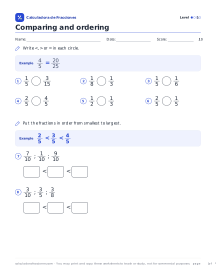
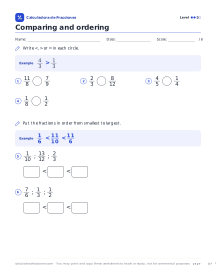
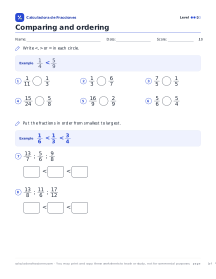
- Comparing and ordering. Use the number line as the picture.
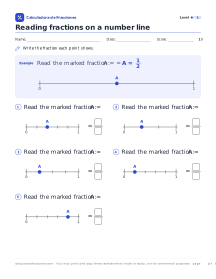
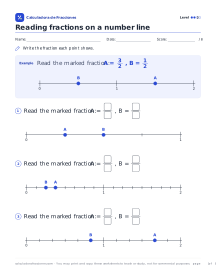
- Reading fractions on a number line. Go back to the number line with more reading problems.
A student who finishes a level 1 sheet with no errors can move to level 2 of the same topic. For more practice on one skill, see the number line worksheets and the equivalent fractions worksheets. The fractions on a number line tool draws any fraction on screen.
Common mistakes
- Counting marks instead of spaces. On a number line from 0 to 1 split into 4 equal spaces, the point at the third mark after 0 is 3/4. Counting the 5 marks and writing 3/5 is wrong.
- Choosing the bigger denominator. “3/8 > 3/4 because 8 > 4” is false. With the same numerator, smaller parts mean a smaller fraction, so 3/8 < 3/4.
- Adding the same number to top and bottom. “1/2 = 2/3, because I added 1 to each number” is wrong. Multiply both by 2 instead: 1/2 = 2/4.
The 3rd grade test
The last sheet is a test of 18 problems: 3 on placing fractions on a number line, 3 on reading them, 3 on equivalence, 4 on comparing, 3 on reading drawings and 2 sharing problems. It has its own answer key. Use it at the end of a unit, or hand out only the parts that match what the class has covered.
Teacher notes
- Time. A level 1 sheet takes roughly 10 to 15 minutes (an estimate).
- Same point, same number. Folding a paper strip into halves and then fourths shows 1/2 and 2/4 at the same point.
- Explain with a drawing. 3.NF.A.3.d asks students to justify a comparison, so ask for a sketch next to every answer.
- Standard coverage. Adding and subtracting fractions with like denominators starts in 4th grade (4.NF.B.3), so these sheets do not include it.
- Next grade. The 4th grade worksheets add like-denominator sums and multiplying by a whole number.
To make a sheet with your own settings, use the fraction worksheet generator.
Frequently asked questions
What fractions do 3rd graders need to know?
Halves, thirds, fourths, sixths and eighths (3.NF). They read a fraction as equal parts, place it on a number line, find simple equivalents and compare fractions that share a numerator or a denominator.
How do you compare fractions in 3rd grade?
Only when the numerators or the denominators match. With the same denominator, more parts is larger: 5/8 > 3/8. Record the result with >, = or <.
Do 3rd graders add fractions?
Not as a standard. In 3rd grade they build fractions from unit fractions, such as 3/4 as three fourths, which prepares for addition in 4th grade.