
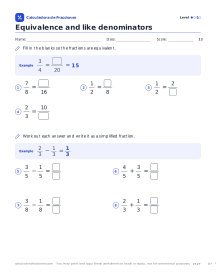
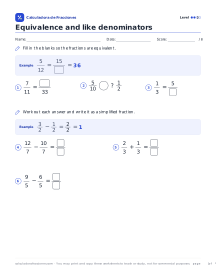
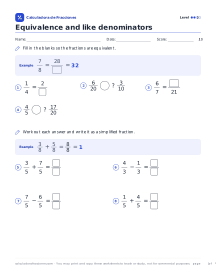
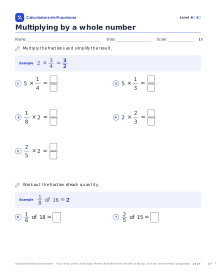
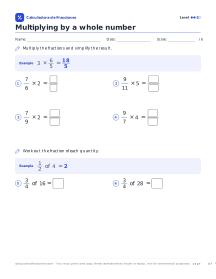
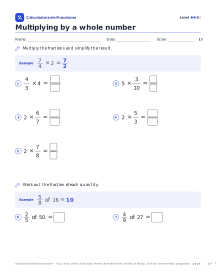
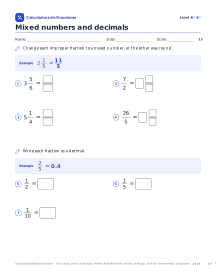
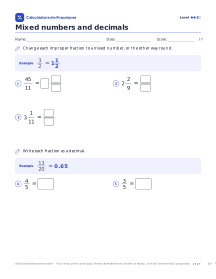
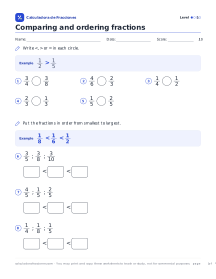
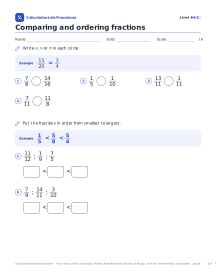
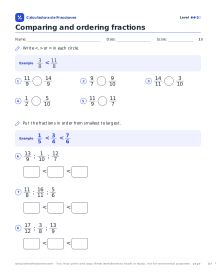
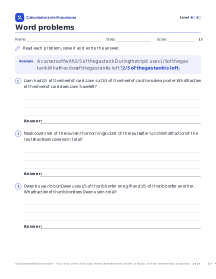
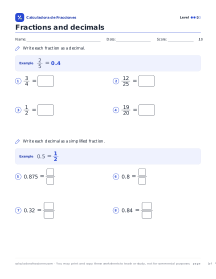
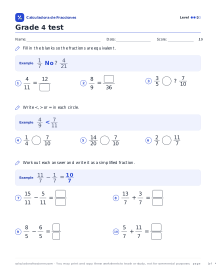
Fourth grade adds operations to fractions: adding and subtracting with like denominators, and multiplying a fraction by a whole number. These worksheets, at levels 1 and 2, cover those skills plus equivalence, comparing and decimal notation, with a 19-problem test at the end. Each sheet has a separate answer key.
What this grade practices
The Common Core fractions domain for grade 4 has three clusters:
| Standard | What students do | Example |
|---|---|---|
| 4.NF.A.1 | Make equivalent fractions by multiplying top and bottom by the same number | 2/3 = 8/12 |
| 4.NF.A.2 | Compare fractions with different numerators and denominators | 3/4 = 6/8 > 5/8 |
| 4.NF.B.3 | Add and subtract fractions and mixed numbers with like denominators | 2 1/4 + 1 3/4 = 4 |
| 4.NF.B.4 | Multiply a fraction by a whole number | 3 × 2/5 = 6/5 |
| 4.NF.C.5–7 | Use tenths and hundredths, write them as decimals and compare decimals | 34/100 = 0.34 (the standard’s example; the sheets do not use 100) |
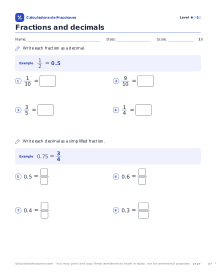
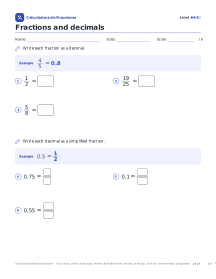
The Common Core uses denominators 2, 3, 4, 5, 6, 8, 10, 12 and 100 in this grade. Level 1 here uses denominators up to 10, and level 2 also uses 7, 9, 11 and 12. Equivalence items can go beyond these, up to 30 at level 1 and 36 at level 2. The decimal sheets convert fractions such as 3/4 = 0.75, which go beyond the denominators of 10 and 100 in 4.NF.C.6, and they do not include a separate tenths-to-hundredths exercise (4.NF.C.5) or decimal-only comparisons (4.NF.C.7). For those, use the fractions, decimals and percents worksheets.
How to use these worksheets
The library has seven topics. Most have a level 1 sheet of 10 problems, a short level 2 sheet of 7 or 8, and a level 2 sheet of 10. A sequence that follows the standards:
- Equivalence with like-denominator sums. This sets up the rest.
- Comparing and ordering. Compare to 1/2 first, then use a common denominator.
- Multiplying by a whole number, with fraction-of-a-quantity problems.
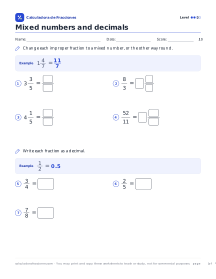
- Mixed numbers, including converting between improper fractions and mixed numbers.
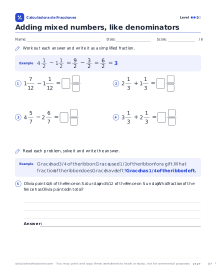
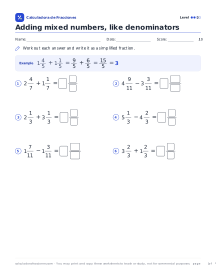
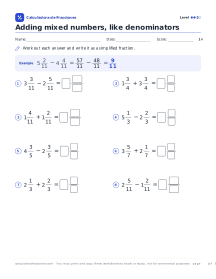
- Adding mixed numbers, with one 14-problem sheet for extra practice.
- Word problems and decimals.
Move up to level 2 when a student gets nearly all level 1 problems right. For single-skill practice, see the add and subtract worksheets and the improper fractions and mixed numbers worksheets.
Common mistakes
- Multiplying the denominator too. 3 × 2/5 = 6/15 is wrong, because 6/15 simplifies to 2/5, which is only one copy. Three copies of 2/5 make 6/5 = 1 1/5.
- Subtracting mixed numbers column by column. In 5 1/5 − 2 3/5, taking 5 − 2 = 3 and 3/5 − 1/5 = 2/5 gives 3 2/5, which is wrong. Convert instead: 26/5 − 13/5 = 13/5 = 2 3/5.
- Comparing the numerators and denominators separately. “5/8 > 3/4, because 5 > 3 and 8 > 4” is wrong. Rewrite 3/4 as 6/8, and then 6/8 > 5/8.
The 4th grade test
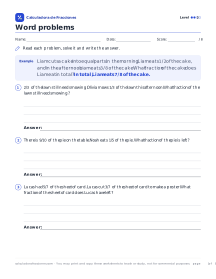
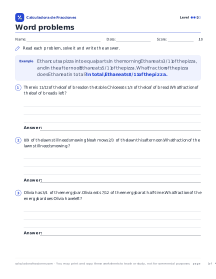
The last sheet is a level 2 test of 19 problems: 3 on equivalence, 3 on comparing, 4 on adding and subtracting with like denominators, 3 on multiplying a fraction by a whole number, 2 on converting between improper fractions and mixed numbers, and 4 word problems. It has a separate answer key. Use it as an end-of-unit check.
Teacher notes
- Time. Plan 10 to 15 minutes for a standard sheet (an estimate).
- Only the numerators change. With like denominators, 3/8 + 2/8 = 5/8, not 5/16. A bar split into eighths shows why.
- Two routes for mixed numbers. Add the wholes and the fractions separately, then regroup: 2 1/4 + 1 3/4 = 3 + 4/4 = 4. Or convert first: 9/4 + 7/4 = 16/4 = 4. Standard 4.NF.B.3.c allows both.
- Benchmarks. Before finding a common denominator, ask whether each fraction is more or less than 1/2.
- Next grade. Adding fractions with unlike denominators waits for the 5th grade worksheets.
For word problems on their own, see fraction add and subtract word problems. To make more sheets, use the fraction worksheet generator.
Frequently asked questions
What fractions do 4th graders learn?
They make equivalent fractions, compare fractions with unlike denominators, add and subtract with like denominators, multiply a fraction by a whole number, and write tenths and hundredths as decimals (4.NF).
How do you multiply a fraction by a whole number?
Multiply the numerator by the whole number and keep the denominator. 3 × 2/5 = 6/5, which is 1 1/5.
How do you compare fractions with different denominators?
Rewrite them with a common denominator or compare each with 1/2. To compare 5/8 and 3/4, write 3/4 as 6/8. Since 6/8 > 5/8, 3/4 is larger.