
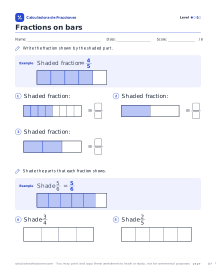
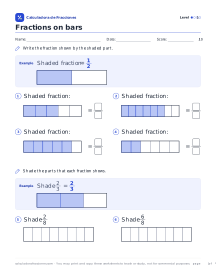
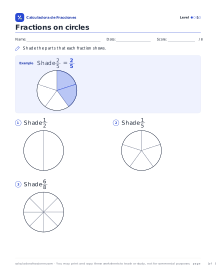
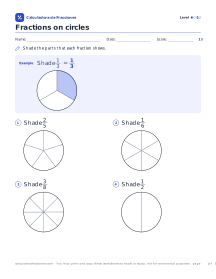
Second graders meet fractions as equal shares: a pizza cut fairly, a bar split in two. These worksheets practice shading, naming and comparing equal shares, and the last one is an 18-problem test with its own answer key. Every sheet is level 1, so all fractions are less than 1.
What this grade practices
The 2nd grade standard is 2.G.A.3 in the Common Core geometry domain: partition circles and rectangles into two, three or four equal shares, name them halves, thirds and fourths, and describe the whole as two halves, three thirds or four fourths. Students also learn that equal shares of identical wholes need not have the same shape.
The sheets stay close to that standard and use these skills:
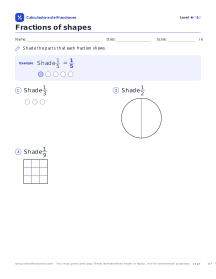
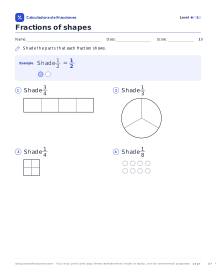
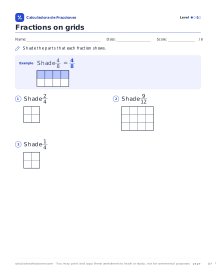
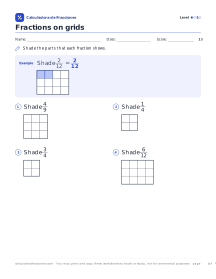
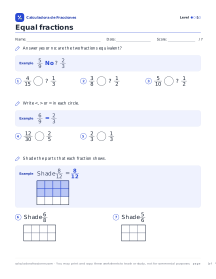
- Shade and read. Shade 1/4 of a circle, or write the fraction a shaded bar shows.
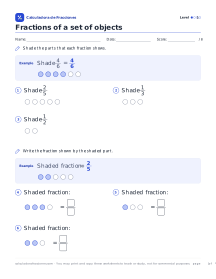
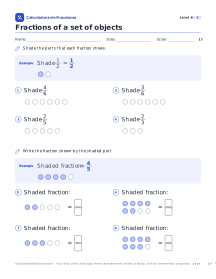
- Sets of objects. 2 of 6 counters shaded is 2/6 of the set.
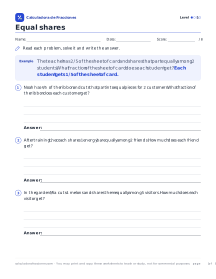
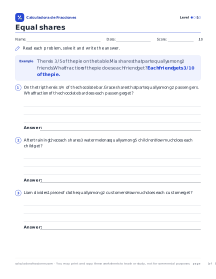
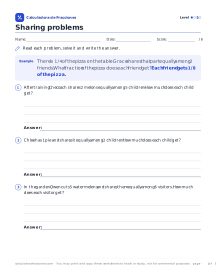
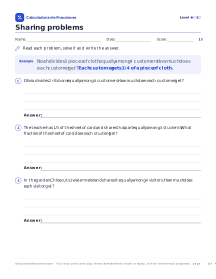
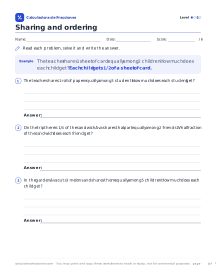
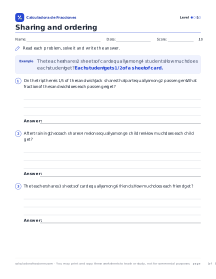
- Sharing problems. Two friends share one sandwich fairly, so each gets 1/2.
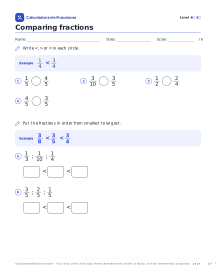
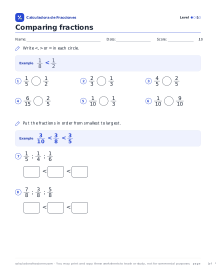
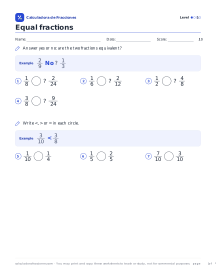
- Comparing. Which is larger, 1/2 or 1/4?
The drawings also use other denominators up to 12, and equivalence items can go beyond that (up to 30). Writing and comparing fractions such as 3/8 belongs to 3rd grade (3.NF.A.1 and 3.NF.A.3), so treat those items as extension.
How to use these worksheets
The library has ten topics, and each has a short sheet (7 or 8 problems) and a standard sheet (10 problems). Work in this order: fractions of shapes, equal shares, then bars, circles and grids, one figure at a time. Sets of objects and sharing problems come next, and comparing and equal fractions come last, because they ask students to reason about size.
If a student names the shaded part correctly on bars but not on circles, repeat the circles sheet rather than moving on. For extra shading practice at any level, use the visual fraction worksheets. The visual fraction models tool draws a fraction on screen for a quick demonstration.
Common mistakes
- Counting shaded against unshaded. In a row of 6 counters with 2 shaded, writing 2/4 is wrong. The denominator counts every counter, so the answer is 2/6.
- Believing a bigger denominator means a bigger fraction. “1/8 is more than 1/4 because 8 is more than 4” is false. A circle cut into 8 equal parts has smaller parts than one cut into 4, so 1/4 > 1/8.
- Thinking equal means the same shape. A 4 by 2 rectangle has 8 squares. A 2 by 2 block (4 squares) and a 4 by 1 strip (4 squares) are both exactly half, even though they look different.
The guide to common fraction mistakes has more examples.
The 2nd grade test
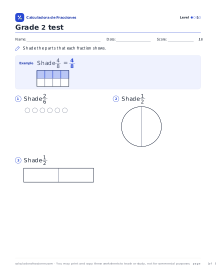
The last sheet in the library is an 18-problem test: 3 shading problems, 3 on reading a drawing, 5 sharing problems, 4 on comparing and 3 on ordering. It has its own answer key. Use it after the topic sheets or to check what a class already knows, and leave out any item the class has not yet met.
Teacher notes
- Time. Plan about 10 minutes for a short sheet (an estimate).
- Words before symbols. 2.G.A.3 uses words, while the sheets write answers such as 1/4. Read it aloud as “one fourth” so the symbol and the word go together.
- Whole as a fraction. 4 fourths make one whole circle, and 2 halves make one whole bar.
- Differentiation. Students who finish early can try the sheets on comparing and equal fractions, which go beyond the standard.
- Next grade. The 3rd grade worksheets move to the number line and equivalent fractions.
To make a sheet with your own settings, use the fraction worksheet generator.
Frequently asked questions
What fractions do 2nd graders learn?
Halves, thirds and fourths of circles and rectangles (2.G.A.3). Students name equal shares in words and see that 4 fourths make one whole.
Do 2nd graders write fractions as numbers?
The standard describes shares in words. Writing a fraction with a numerator and a denominator is introduced formally in 3rd grade, so the answer keys here use both forms.
Is there a 2nd grade fraction test?
Yes. The last sheet is the 18-problem test. It mixes shading, reading drawings, sharing problems, comparing and ordering.
Where does this fit before 2nd grade?
In 1st grade, standard 1.G.A.3 covers halves, fourths and quarters of shapes. The shading sheets here also work for that.