
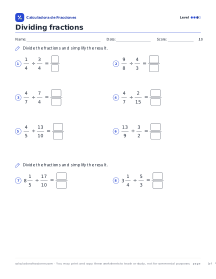
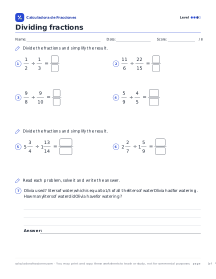
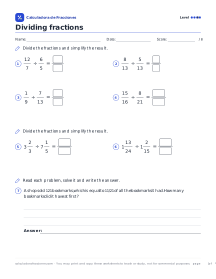
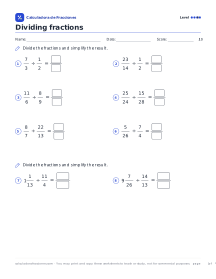
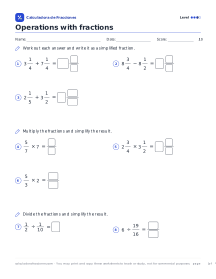
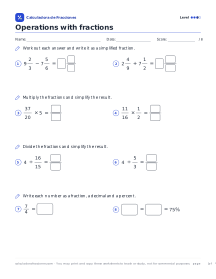
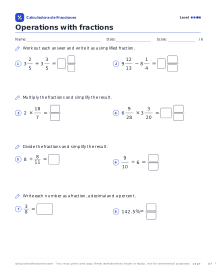
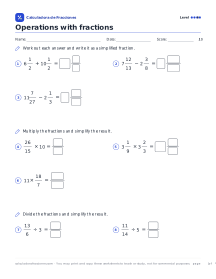
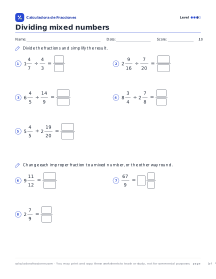
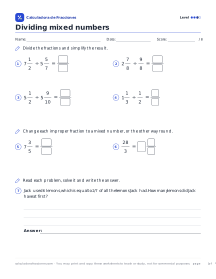
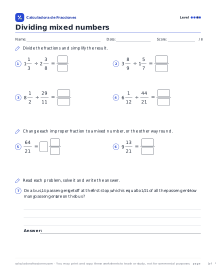
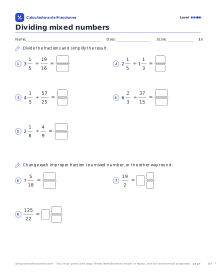
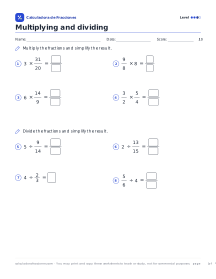
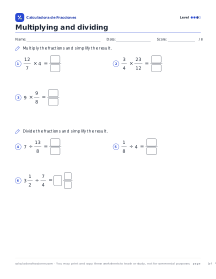
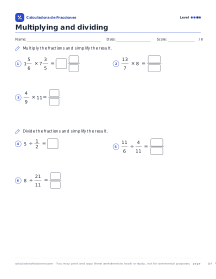
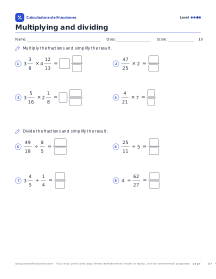
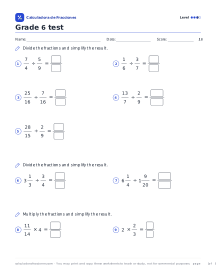
Sixth grade has one fraction-division standard: a fraction divided by a fraction, and word problems that use it. These worksheets, at levels 3 and 4, practice that standard and keep the other operations in play. The last sheet is an 18-problem test, and every sheet has a separate answer key.
What this grade practices
6.NS.A.1, in the Common Core Number System domain for grade 6, asks students to interpret and compute quotients of fractions and to solve word problems that divide a fraction by a fraction. The standard’s own example asks how much chocolate each person gets when 3 people share 1/2 lb equally: 1/2 ÷ 3 = 1/6 lb.
The sheets use these problem types:
- Fraction by fraction. 2/3 ÷ 3/4 = 2/3 × 4/3 = 8/9.
- How many fit. 3/4 ÷ 1/8 = 6, because six eighths make three fourths.
- Mixed numbers. Convert first: 1 3/4 ÷ 1/2 = 7/4 × 2 = 7/2 = 3 1/2.
- Finding the whole. If 3/4 of a length is 12 m, the whole is 12 ÷ 3/4 = 16 m.
Some sheets also mix in addition, subtraction and multiplication of fractions, so students keep all four operations fresh. Some level 4 sheets, including the fraction word problems, include a few exercises with negative numbers and squares, which belong to 7th grade (7.NS) and can be skipped or used as extension.
How to use these worksheets
The library has six topics, each in four sheets: level 3 with 10 and 8 problems, and level 4 with 8 and 10. Level 3 uses denominators up to 20, and level 4 up to 30 with larger whole numbers and results.
- Dividing fractions. Start here, because it is the standard itself.
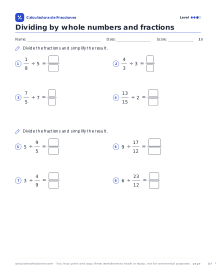
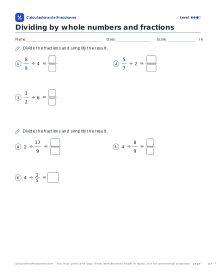
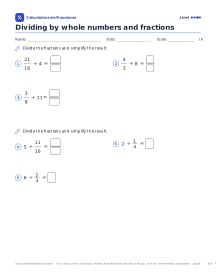
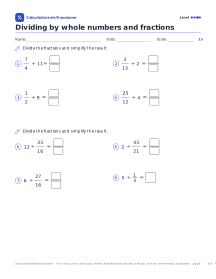
- Dividing by whole numbers and whole numbers by fractions. This links back to 5th grade.
- Dividing mixed numbers, with conversion practice.
- Multiplying and dividing, with fraction-of-a-quantity problems.
- Operations with fractions. All four operations, plus conversions between fractions, decimals and percents.
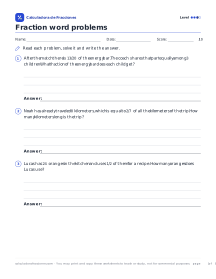
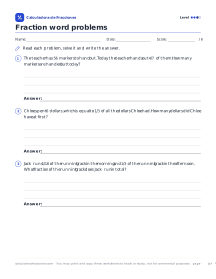
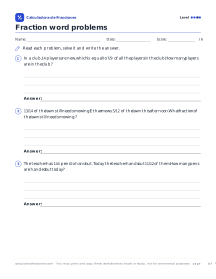
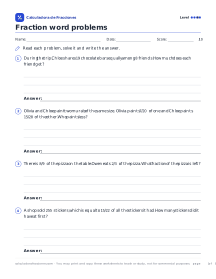
- Fraction word problems, with combined operations.
Students who need support can go back to the 5th grade worksheets. For division only, see the dividing fractions worksheets and fraction division word problems. The divide fractions calculator shows each step for a single problem.
Common mistakes
- Flipping the dividend. 2/3 ÷ 3/4 = 3/2 × 3/4 = 9/8 is wrong. Flip the divisor: 2/3 × 4/3 = 8/9.
- Multiplying when dividing by a whole number. 1/2 ÷ 3 = 3/2 is wrong, because sharing 1/2 among 3 people gives each less than 1/2. Dividing by 3 is multiplying by 1/3: 1/2 × 1/3 = 1/6.
- Expecting the answer to be smaller. 3/4 ÷ 1/8 = 3/32 is wrong. Count the eighths in 3/4 instead: 3/4 = 6/8, so the answer is 6.
The 6th grade test
The last sheet is a level 3 test of 18 problems: 5 on dividing a fraction by a fraction, 2 on dividing mixed numbers, 3 on multiplying, 3 on adding and subtracting, and 5 word problems. Its answer key is separate. It works as a check before moving on to ratios and expressions.
Teacher notes
- Time. Plan 15 to 20 minutes for a standard sheet (an estimate).
- Why the reciprocal works. 3/4 ÷ 1/8 asks how many eighths fit in 3/4. Rewriting 3/4 as 6/8 gives 6 without any rule, and it matches 3/4 × 8.
- Check the size. Dividing by a fraction less than 1 gives a result larger than the dividend: 6 > 3/4.
- Use a model. 6.NS.A.1 expects visual fraction models, so ask students to sketch a bar or a number line for at least one problem per sheet.
- Beyond this grade. Fractions in 7th grade extend to negative numbers (7.NS.A.1–3). The order of operations worksheets give practice with combined operations.
To make more sheets with your own settings, use the fraction worksheet generator.
Frequently asked questions
What fraction skills are taught in 6th grade?
Dividing a fraction by a fraction and solving word problems with it (6.NS.A.1). Students also use fractions in ratios, rates and expressions.
How do you divide fractions?
Multiply the first fraction by the reciprocal of the second. 2/3 ÷ 3/4 = 2/3 × 4/3 = 8/9. For mixed numbers, convert to improper fractions first.
Why does dividing by a fraction give a bigger number?
Dividing by a fraction less than 1 counts how many small pieces fit in the dividend. Six pieces of 1/8 fit in 3/4, so 3/4 ÷ 1/8 = 6. The smaller the divisor, the more pieces fit.