
A scale of 1:n says that a length on the map equals n times that same length on the ground. At 1:50,000, 1 cm on the map is 50,000 cm in reality, which is 500 m. Because the scale is the fraction 1/50,000, going from map to ground means multiplying by 50,000, and going back to the map means dividing by 50,000. If you want to set up a proportion with units, see the rule of three; and when one of the four quantities in a/b = c/d is missing, use the proportion calculator.
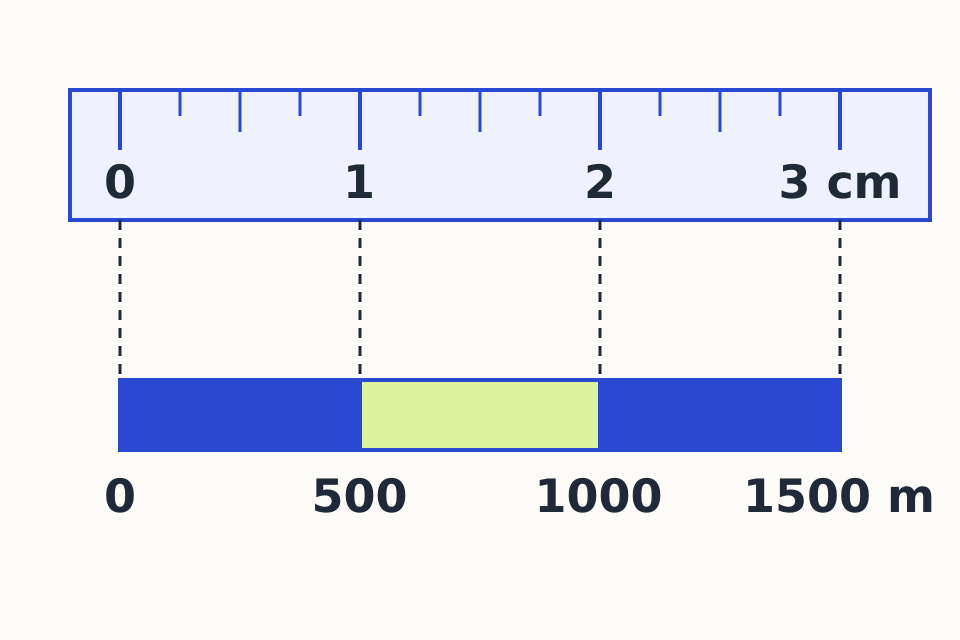
Which operation to use for what you want to find
Map and ground must be in the same unit, so before dividing, the real distance is converted to centimeters, and after multiplying, the result is converted to meters or kilometers.
| You want to find | Operation | Example at 1:50,000 |
|---|---|---|
| The real distance | Map measurement × n | 5 cm × 50,000 = 250,000 cm = 2.5 km |
| The length on the map | Real distance in cm ÷ n | 4 km is 400,000 cm, and 400,000 ÷ 50,000 = 8 cm |
| The scale | Real distance ÷ map measurement, in the same unit | 2 cm ↔ 1 km, so 100,000 ÷ 2 = 50,000, scale 1:50,000 |
The middle row is where most mistakes happen: the 4 km are converted to centimeters before dividing. Dividing 4 by 50,000 mixes kilometers with centimeters and gives a meaningless number.
Worked example: 3 cm on a 1:50,000 map
A route measures 3 cm on a map at a scale of 1:50,000. How many kilometers is that on the ground?
- Multiply by the denominator. 3 × 50,000 = 150,000 cm.
- Convert to meters. 100 cm make 1 m, so 150,000 cm is 1500 m.
- Convert to kilometers. 1000 m make 1 km, so 1500 m is 1.5 km (about 0.9 mi).
On the ground it is 1.5 km.
Check. 1 cm is 500 m, and 3 × 500 m = 1500 m.
How 1:25,000 and 1:50,000 compare
The 1:25,000 scale is the larger of the two, because 1/25,000 is greater than 1/50,000. The same centimeter on the map covers less ground, and the drawing carries more detail.
| Scale | 1 cm on the map | 4 cm on the map |
|---|---|---|
| 1:25,000 | 250 m | 1 km |
| 1:50,000 | 500 m | 2 km |
| 1:100,000 | 1 km | 4 km |
When you double the denominator, each centimeter stands for twice as much ground and the sheet covers four times as much area, even though it has the same size. A larger scale is better for planning a short stretch, and a smaller one for seeing the whole region.
How to measure a winding route
A winding route is measured in nearly straight segments, with a piece of string or a ruler, and the measurements are added before applying the scale. If three segments measure 1.5 cm, 0.5 cm and 2.5 cm, the total is 4.5 cm. At 1:50,000, 4.5 cm is 225,000 cm, which is 2.25 km. The straight line between start and finish is shorter than the route, so it gives a minimum, not the distance walked.
What happens when a copy changes size
The numerical scale holds for the map at its original size. If you print or photocopy a 1:50,000 map at 80%, each centimeter of the copy represents more ground than before: 50,000 ÷ 4/5 = 62,500, so the copy is a 1:62,500 map in which 1 cm is 625 m. If you measure 4 cm on that copy using the original scale, you would get 2 km, but the real distance is 2500 m. The scale bar shrinks along with the drawing and stays valid, as long as it has not been cropped.
Practice
- At 1:50,000, a stretch measures 7 cm on the map. How many kilometers is it?
- At 1:25,000, a track is 5 km long. How many centimeters does it take up on the map?
- A 3 km road measures 6 cm on the map. What is the scale?
See the answers
- 7 × 50,000 = 350,000 cm = 3.5 km.
- 5 km = 500,000 cm, and 500,000 ÷ 25,000 = 20 cm.
- 3 km = 300,000 cm, and 300,000 ÷ 6 = 50,000, so the scale is 1:50,000.
Where to go next
To understand why a scale is a ratio and when it can be written as a fraction, see ratio, proportion and fraction. If a ratio such as 4 : 6 needs reducing before you use it, the simplify ratios calculator puts it in its simplest form. To take a part of a length, such as 3/5 of a stretch, there is fraction of a number.
The scales in this text are illustrative and do not correspond to a specific map; before measuring on a real one, check the scale in its legend.
Sources
Wikipedia, article Map scale, which defines scale as the ratio of a distance on the map to the corresponding distance on the ground, gives 1:50,000 as 500 m per centimeter, and describes the graphic (bar) scale (accessed October 17, 2026).